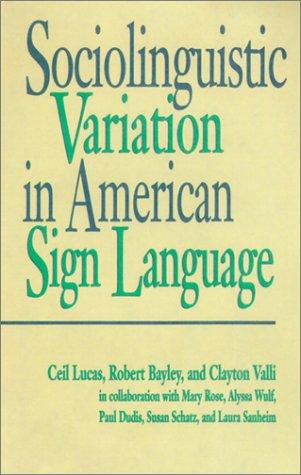
Sociolinguistic Variation in American Sign Language
0
0
As an Amazon Associate and affiliate partner, Menrva Books earns from qualifying purchases. Learn more
Author Description
This volume provides a complete description of ASL variation. People from varying regions and backgrounds have different ways of saying the same thing. For example, in English some people say "test," while others say "tes'," dropping the final "t." Noted scholars Ceil Lucas, Robert Bayley, and Clayton Valli led a team of exceptional researchers in applying techniques for analyzing spoken language variation to ASL. Their observations at the phonological, lexical, morphological, and syntactic levels demonstrate that ASL variation correlates with many of the same driving social factors of spoken languages, including age, socioeconomic class, gender, ethnic background, region, and sexual orientation. Internal constraints that mandate variant choices for spoken languages have been compared to ASL as well, with intriguing results.
Menrva's Summary
THE THESIS
This volume investigates the diverse ways in which American Sign Language (ASL) varies across different populations and regions. The authors, led by noted scholars Ceil Lucas, Robert Bayley, and Clayton Valli, apply established techniques for analyzing spoken language variation to ASL. Their research examines phonological, lexical, morphological, and syntactic levels to demonstrate how social factors such as age, socioeconomic class, gender, ethnic background, region, and sexual orientation influence ASL usage. The study also explores internal linguistic constraints that shape variant choices in ASL, yielding significant findings.
THE SCOPE MAP
- Analysis of sociolinguistic variation in American Sign Language (ASL).
- Application of spoken language variation analysis techniques to ASL.
- Examination of variation at phonological, lexical, morphological, and syntactic levels.
- Correlation of ASL variation with social factors: age, socioeconomic class, gender, ethnicity, region, and sexual orientation.
- Investigation of internal linguistic constraints on variant choices in ASL.
- Demonstration of ASL variation mirroring patterns found in spoken languages.
- Insights from a team of exceptional researchers led by Ceil Lucas, Robert Bayley, and Clayton Valli.
THE AUTHORITY PERSPECTIVE
This seminal work is recognized for its rigorous application of sociolinguistic methodologies to American Sign Language, providing a comprehensive account of ASL variation. Scholars have lauded the research for its detailed analysis across multiple linguistic levels and its clear demonstration of how social factors shape the language. The book is considered essential reading for linguists, ASL researchers, and anyone interested in the sociolinguistics of signed languages. Its findings offer significant contributions to the understanding of language diversity and its relationship with society.
Page Count:
192
Publication Date:
2001-01-01
ISBN-10:
1563681137
ISBN-13:
9781563681134
Literary Fiction
Non-Fiction
Social Factors
Linguistics
Community Tags
Similar Books