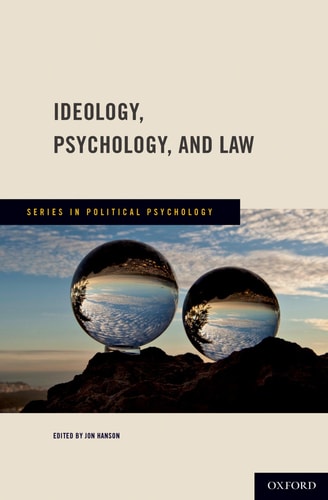
Ideology, Psychology, and Law
0
0
As an Amazon Associate and affiliate partner, Menrva Books earns from qualifying purchases. Learn more
Author Description
Formally, the law is based solely on reasoned analysis, devoid of ideological biases or unconscious influences. Judges claim to act as umpires applying the rules, not making them. They frame their decisions as straightforward applications of an established set of legal doctrines, principles, and mandates to a given set of facts. As most legal scholars understand, however, the impression that the legal system projects is largely an illusion. As far back as 1881, Oliver Wendell Holmes, Jr. made a similar claim, writing that "the felt necessities of the time, the prevalent moral and political theories, intuitions of public policy, avowed or unconscious, even the prejudices which judges share with their fellow-men, have a good deal more to do than the syllogism in determining the rules by which men should be governed."More than a century later, we are now much closer to understanding the mechanisms responsible for the gap between the formal face of the law and the actual forces shaping it. Over the last decade or so, political scientists and legal academics have begun studying the linkages between ideologies, on one hand, and legal principles and policy outcomes on the other. During that same period, mind scientists have turned to understanding the psychological sources of ideology. This book is the first to bring many of the world's experts on those topics together to examine the sometimes unsettling interactions between psychology, ideology, and law, and to better understand what, beyond and beneath the logic, animates the law.
Menrva's Summary
THE THESIS
This book investigates the extent to which ideological biases and psychological factors, rather than purely reasoned analysis, influence the formation and application of legal decisions. John Jost, a prominent scholar in political psychology, compiles research from experts across multiple disciplines to bridge the gap between formal legal theory and the behavioral realities of the judiciary. The text argues that the traditional view of judges as neutral arbiters is an illusion, proposing instead that legal outcomes are deeply intertwined with the unconscious prejudices and political theories held by those in power.
THE SCOPE MAP
What You Will Find
- Analysis of the psychological mechanisms that underpin political and legal ideologies.
- Examination of the historical gap between formal legal doctrine and judicial practice.
- Synthesis of research from political science, legal studies, and cognitive psychology.
- Case studies and theoretical frameworks explaining how societal moral theories shape public policy.
THE AUTHORITY PERSPECTIVE
Experts recognize this volume as a foundational interdisciplinary resource for understanding the intersection of behavioral science and jurisprudence. Readers frequently note the academic density of the prose, which serves as a comprehensive reference for scholars and students interested in the hidden drivers of the legal system.
Page Count:
816
Publication Date:
2012-01-11
Publisher:
Oxford University Press
ISBN-10:
0199737517
ISBN-13:
9780199737512
Non-Fiction
Psychology
Law
Sociology
Ideology
Community Tags
Similar Books