
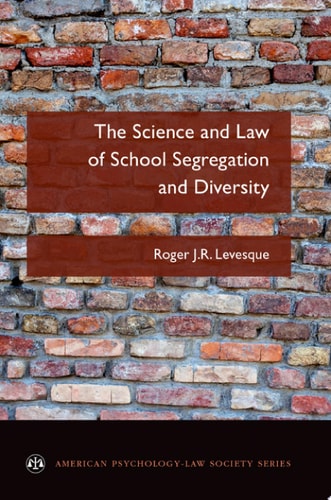
The Science and Law of School Segregation and Diversity
0
0
As an Amazon Associate and affiliate partner, Menrva Books earns from qualifying purchases. Learn more
Author Description
An empirical look at the U.S legal system's effectiveness in addressing school segregation reveals that segregation persists and even surpasses levels experienced before the Civil Rights Movement. Yet, lawmaking continues as though segregation is a thing of the past. The negative effects of racial and ethnic disparities in schooling are well documented, but legal analysts increasingly interpret the law as a system that operates independently of research findings clearly pointing to disparities. For their part, researchers continue to document experiences of segregation without considering the legal system's basic concerns.The Science and Law of School Segregation and Diversity examines the sources of the disconnect between scientific findings on school segregation and how the U.S. legal system addresses it; evaluates these sources' empirical and legal foundations; explains why they persist; and reveals what can be done about them. Roger Levesque, a scholar with expertise in children's rights, family law, and adolescence, provides an overview of how the legal system approaches inequality based on racial/ethnic status. He presents an analysis of the empirical findings relating to the implementation of laws that would address racial disparities in schooling and educational outcomes. Finally, Levesque challenges jurisprudential claims that the developmental sciences do not offer important and useful tools to guide responses to differential treatment and circumstances based on race. This book will appeal to individuals interested in legal responses to schooling's place in society, discrimination, diversity, inequality, and more broadly, civil rights. The text will also appeal to developmentalists interested in prejudice, discrimination, and social development, and researchers, scholars, and students in law and psychology, law and education, law and human development, and law and society.
Menrva's Summary
THE THESIS
This book investigates the persistent disconnect between empirical scientific research on school segregation and the U.S. legal system's failure to effectively address racial and ethnic disparities in education. Roger J.R. Levesque, an expert in children's rights and family law, utilizes a multidisciplinary framework to analyze why legal institutions often ignore developmental science. He argues that the current jurisprudential approach is insufficient and proposes that integrating scientific findings is necessary to create meaningful policy changes regarding educational equity.
THE SCOPE MAP
What You Will Find
- Analysis of the historical and current state of school segregation in the United States.
- Evaluation of the empirical and legal foundations of existing educational laws.
- Examination of the role of developmental science in informing legal responses to discrimination.
- Proposed strategies for bridging the gap between social science research and legal practice.
Scope Limits
- The text focuses primarily on the U.S. legal system and may not address international comparative law in depth.
- It does not provide a comprehensive history of every civil rights case but rather focuses on the systemic disconnect between science and law.
THE AUTHORITY PERSPECTIVE
Experts and scholars in the fields of law, psychology, and education recognize this work as a critical examination of the intersection between social science and jurisprudence. Readers frequently note the academic rigor and the author's ability to synthesize complex legal and developmental data into a coherent critique of current educational policy.
Page Count:
166
Publication Date:
2017-10-25
Publisher:
Oxford University Press
ISBN-10:
0190633638
ISBN-13:
9780190633639
Psychology
Sociology
Public Policy
Education
United States
Civil Rights
Professional Career & Trade
Law And Legislation
Law
Community Tags
Other Editions(3)
Similar Books








Reader Comments
Share Your Thoughts
No comments yet. Be the first to share your thoughts!