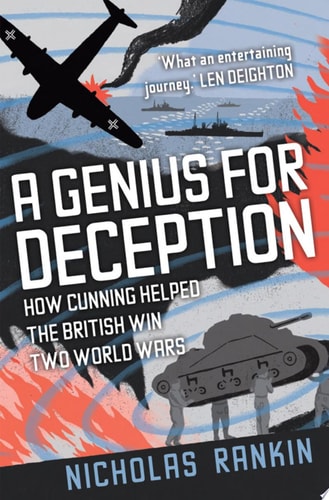
A Genius for Deception
0
0
As an Amazon Associate and affiliate partner, Menrva Books earns from qualifying purchases. Learn more
Author Description
In February 1942, Intelligence Officer Victor Jones erected 150 tents behind British lines in North Africa. Hiding tanks in Bedouin tents was an old British trick, writes Nicholas Rankin. German General Erwin Rommel not only knew of the ploy, but had copied it himself. Jones knew that Rommel knew. In fact, he counted on it--for these tents were empty. With the deception that he was carrying out a deception, Jones made a weak point look like a trap. In A Genius for Deception, Nicholas Rankin offers a lively and comprehensive history of how Britain bluffed, tricked, and spied its way to victory in two World Wars. As Rankin shows, a coherent program of strategic deception emerged in World War I, resting on the pillars of camouflage, propaganda, secret intelligence, and special forces. All forms of deception found an avid sponsor in Winston Churchill, who carried his enthusiasm for deceiving the enemy into World War II. Rankin vividly recounts such little-known episodes as the invention of camouflage by two French artist-soldiers, the creation of dummy airfields for the Germans to bomb during the Blitz, and the fabrication of an army that would supposedly invade Greece. Strategic deception would be key to a number of WWII battles, culminating in the massive misdirection that proved critical to the success of the D-Day invasion in 1944. Deeply researched and written with an eye for telling detail, A Genius for Deception shows how the British used craft and cunning to help win the most devastating wars in human history.
Menrva's Summary
THE THESIS
How did British military intelligence leverage strategic deception, camouflage, and psychological warfare to alter the outcomes of the two World Wars? Nicholas Rankin, an experienced historian, examines the evolution of British clandestine operations from the early 20th century through 1945. By synthesizing archival research and historical accounts, he argues that a systematic, state-sponsored program of misdirection was a fundamental pillar of British military success, championed by leaders like Winston Churchill.
THE SCOPE MAP
What You Will Find
- Historical analysis of the development of camouflage, propaganda, and special forces operations.
- Detailed accounts of specific deception campaigns, including dummy airfields and phantom armies.
- Examination of the role of Winston Churchill in fostering a culture of strategic trickery.
- Evaluation of the impact of intelligence operations on major conflicts like the North African campaign and the D-Day invasion.
THE AUTHORITY PERSPECTIVE
Historians and military enthusiasts frequently cite this work for its detailed documentation of obscure intelligence operations. Readers often note the accessible prose style, which balances academic rigor with a narrative focus on the individuals behind these complex tactical maneuvers.
Page Count:
480
Publication Date:
2009-01-01
Publisher:
Oxford University Press
ISBN-10:
0199739501
ISBN-13:
9780199739509
History
Military History
Espionage
Strategy
Community Tags
Similar Books