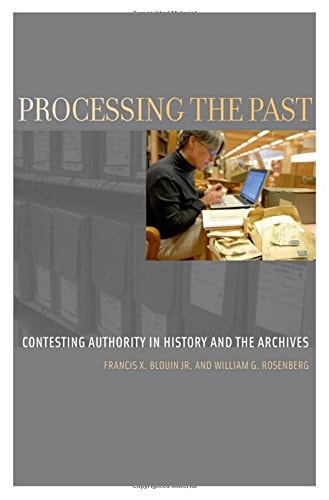
Processing the Past: Contesting Authority in History and the Archives
0
0
As an Amazon Associate and affiliate partner, Menrva Books earns from qualifying purchases. Learn more
Author Description
Processing the Past explores the dramatic changes taking place in historical understanding and archival management, and hence the relations between historians and archivists. Written by an archivist and a historian, it shows how these changes have been brought on by new historical thinking, new conceptions of archives, changing notions of historical authority, modifications in archival practices, and new information technologies. The book takes an "archival turn" by situating archives as subjects rather than places of study, and examining the increasingly problematic relationships between historical and archival work.By showing how nineteenth- and early twentieth-century historians and archivists in Europe and North America came to occupy the same conceptual and methodological space, the book sets the background to these changes. In the past, authoritative history was based on authoritative archives and mutual understandings of scientific research. These connections changed as historians began to ask questions not easily answered by traditional documentation, and archivists began to confront an unmanageable increase in the amount of material they processed and the challenges of new electronic technologies.The authors contend that historians and archivists have divided into two entirely separate professions with distinct conceptual frameworks, training, and purposes, as well as different understandings of the authorities that govern their work. Processing the Past moves toward bridging this divide by speaking in one voice to these very different audiences. Blouin and Rosenberg conclude by raising the worrisome question of what future historical archives might be like if historical scholars and archivists no longer understand each other, and indeed, whether their now different notions of what is archival and historical will ever again be joined.
Menrva's Summary
THE THESIS
This book investigates the widening professional and conceptual divide between historians and archivists in the face of evolving historical methodologies and digital information management. Francis X. Blouin Jr., an archivist, and William G. Rosenberg, a historian, utilize their combined expertise to analyze the historical evolution of their respective fields. They argue that the traditional alignment between archival preservation and historical research has fractured, necessitating a re-evaluation of how authority is constructed within the archive. The authors present a framework for understanding the 'archival turn,' where the archive itself becomes a primary subject of critical inquiry rather than a passive repository.
THE SCOPE MAP
What You Will Find
- Historical analysis of the professional convergence and divergence of historians and archivists in Europe and North America.
- Examination of the impact of electronic technologies and information overload on archival management.
- Discussion of the shifting definitions of historical authority and the nature of documentation.
- Case studies illustrating the disconnect between modern historical research questions and traditional archival practices.
THE AUTHORITY PERSPECTIVE
Experts in library and information science identify this work as a foundational text for understanding the modern tension between archival theory and historical practice. Readers frequently note the academic density of the prose, which serves as a critical bridge for professionals working in both disciplines.
Page Count:
272
Publication Date:
2011-02-18
Publisher:
Oxford University Press
ISBN-10:
0199740542
ISBN-13:
9780199740543
History
Information Management
Information Science
Historiography
Archives
History
Academic
Community Tags
Other Editions(2)
Similar Books




Reader Comments
Share Your Thoughts
No comments yet. Be the first to share your thoughts!