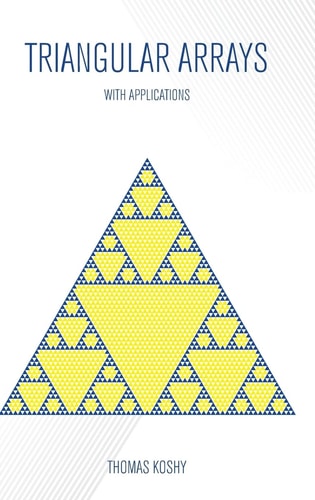
Triangular Arrays with Applications
0
0
As an Amazon Associate and affiliate partner, Menrva Books earns from qualifying purchases. Learn more
Author Description
Triangular arrays are a unifying thread throughout various areas of discrete mathematics such as number theory and combinatorics. They can be used to sharpen a variety of mathematical skills and tools, such as pattern recognition, conjecturing, proof-techniques, and problem-solving techniques.While a good deal of research exists concerning triangular arrays and their applications, the information is scattered in various journals and is inaccessible to many mathematicians. This is the first text that will collect and organize the information and present it in a clear and comprehensive introduction to the topic. An invaluable resource book, it gives a historical introduction to Pascal's triangle and covers application topics such as binomial coefficients, figurate numbers, Fibonacci and Lucas numbers, Pell and Pell-Lucas numbers, graph theory, Fibonomial and tribinomial coefficients and Fibonacci and Lucas polynomials, amongst others. The book also features the historical development of triangular arrays, including short biographies of prominent mathematicians, along with the name and affiliation of every discoverer and year of discovery. The book is intended for mathematicians as well as computer scientists, math and science teachers, advanced high school students, and those with mathematical curiosity and maturity.
Menrva's Summary
THE THESIS
This text investigates the mathematical utility and historical development of triangular arrays as a unifying framework across discrete mathematics. Thomas Koshy, a recognized author in the field of discrete mathematics, synthesizes scattered research into a cohesive volume. The book provides a structured approach to understanding how these arrays facilitate pattern recognition, proof techniques, and problem-solving in various mathematical domains.
THE SCOPE MAP
What You Will Find
- Comprehensive coverage of binomial coefficients, figurate numbers, and Fibonacci-related sequences.
- Historical analysis of Pascal's triangle and the chronological development of array discoveries.
- Biographical sketches of prominent mathematicians associated with specific array properties.
- Practical applications in graph theory and polynomial studies.
THE AUTHORITY PERSPECTIVE
Experts identify this work as a primary reference for consolidating disparate research on triangular arrays into a single, accessible volume. Readers frequently note the technical density of the prose, which is tailored for mathematicians, computer scientists, and advanced students with significant mathematical maturity.
Page Count:
438
Publication Date:
2011-02-25
Publisher:
Oxford University Press
ISBN-10:
0199742944
ISBN-13:
9780199742943
Combinatorics
Reference
Mathematics
Discrete Mathematics
Number Theory
Community Tags
Similar Books