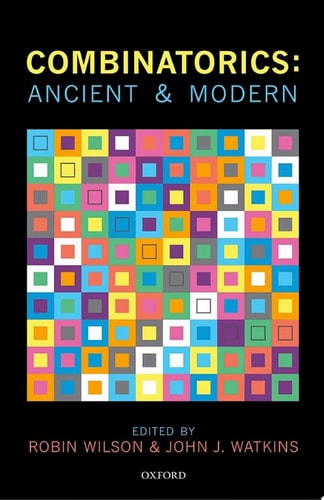
Combinatorics: Ancient & Modern
0
0
As an Amazon Associate and affiliate partner, Menrva Books earns from qualifying purchases. Learn more
Author Description
Who first presented Pascal's triangle? (It was not Pascal.) Who first presented Hamiltonian graphs? (It was not Hamilton.) Who first presented Steiner triple systems? (It was not Steiner.) The history of mathematics is a well-studied and vibrant area of research, with books and scholarly articles published on various aspects of the subject. Yet, the history of combinatorics seems to have been largely overlooked. This book goes some way to redress this and serves two main purposes: 1) it constitutes the first book-length survey of the history of combinatorics; and 2) it assembles, for the first time in a single source, researches on the history of combinatorics that would otherwise be inaccessible to the general reader. Individual chapters have been contributed by sixteen experts. The book opens with an introduction by Donald E. Knuth to two thousand years of combinatorics. This is followed by seven chapters on early combinatorics, leading from Indian and Chinese writings on permutations to late-Renaissance publications on the arithmetical triangle. The next seven chapters trace the subsequent story, from Euler's contributions to such wide-ranging topics as partitions, polyhedra, and latin squares to the 20th century advances in combinatorial set theory, enumeration, and graph theory. The book concludes with some combinatorial reflections by the distinguished combinatorialist, Peter J. Cameron. This book is not expected to be read from cover to cover, although it can be. Rather, it aims to serve as a valuable resource to a variety of audiences. Combinatorialists with little or no knowledge about the development of their subject will find the historical treatment stimulating. A historian of mathematics will view its assorted surveys as an encouragement for further research in combinatorics. The more general reader will discover an introduction to a fascinating and too little known subject that continues to stimulate and inspire the work of scholars today.
Menrva's Summary
THE THESIS
This book investigates the historical development of combinatorics to address the lack of comprehensive literature on the subject's origins and evolution. Authors John J. Watkins and Robin James Wilson curate contributions from sixteen experts to provide a structured survey of combinatorial thought, spanning from ancient mathematical traditions to 20th-century advancements. The text serves as both a historical record and a resource for scholars to understand the provenance of key combinatorial concepts often misattributed to later mathematicians.
THE SCOPE MAP
What You Will Find
- Historical analysis of Indian and Chinese permutations
- Evolution of the arithmetical triangle through the Renaissance
- Euler's contributions to partitions, polyhedra, and latin squares
- Development of 20th-century graph theory and combinatorial set theory
- Introductory reflections by Donald E. Knuth and concluding insights by Peter J. Cameron
Scope Limits
- The text does not function as a comprehensive textbook for learning combinatorial techniques
- It does not provide an exhaustive biography of every mathematician involved in the field
THE AUTHORITY PERSPECTIVE
Experts recognize this work as a foundational survey that fills a significant gap in the history of mathematics literature. Readers frequently note that the collection of expert-contributed chapters provides a high level of academic rigor while remaining accessible to those interested in the evolution of mathematical thought.
Page Count:
392
Publication Date:
2013-01-01
Publisher:
OUP Oxford
ISBN-10:
0191630632
ISBN-13:
9780191630637
Mathematics Statistics
Reference
Combinatorics
Post-Calculus
Mathematics
Discrete Mathematics
Mathematics history
Academic
Community Tags
Similar Books