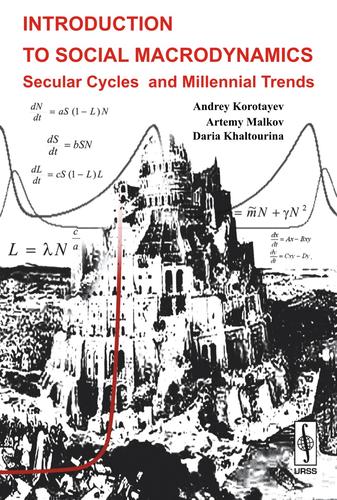
Introduction to Social Macrodynamics
0
0
As an Amazon Associate and affiliate partner, Menrva Books earns from qualifying purchases. Learn more
Author Description
From the review by Robert Bates Graber (Professor Emeritus of Anthropology, Division of Social Science, Truman State University) of "Introduction to Social Macrodynamics" (Three Volumes. Moscow: URSS, 2006) (published in "Social Evolution & History". Vol. 7/2 (2008)): This interesting work is an English translation, in three brief volumes, of an amended and expanded version of the Russian work published in 2005. In terms coined recently by Peter Turchin, the first volume focuses on “millennial trends,” the latter two on “secular cycles” a century or two in duration. The second volume is subtitled "Secular Cycles and Millennial Trends". Chapter 1 stresses that demographic cycles are not, as often has been thought, unique to China and Europe, but are associated with complex agrarian systems in general; and it reviews previous approaches to modeling such cycles. Due to data considerations, the lengthy chapter 2 focuses on China. In the course of assessing previous work, the authors, though writing of agrarian societies in particular, characterize nicely what is, in larger view, the essential dilemma reached by every growing human population: "In agrarian society within fifty years such population growth [0.6 percent per year] leads to diminishing of per capita resources, after which population growth slows down; then either solutions to resource problems (through some innovations) are found and population growth rate increases, or (more frequently) such solutions are not found (or are not adequate), and population growth further declines (sometimes below zero)" (p. 61–62). (Indeed, for humans, technological solutions that raise carrying capacity are always a presumptive alternative to demographic collapse; therefore, asserting—or even proving—that a particular population “exceeded its carrying capacity” is not sufficient to account logically for the collapse of either a political system or an entire civilizations.) Interestingly, the authors find evidence that China’s
Menrva's Summary
THE THESIS
This work investigates the nature of demographic cycles and their relationship to secular trends in agrarian societies across different civilizations. The author, Andrey Korotayev, presents an amended and expanded English translation of his 2005 Russian work, structured into three volumes. The first volume examines "millennial trends," while the subsequent two volumes focus on "secular cycles" of one to two centuries in duration, with the second volume specifically subtitled "Secular Cycles and Millennial Trends." The book emphasizes that demographic cycles are not confined to China and Europe but are inherent to complex agrarian systems globally. It critically assesses previous models of such cycles, particularly highlighting China due to data availability.
THE SCOPE MAP
- Analysis of demographic cycles in agrarian societies beyond China and Europe.
- Detailed examination of China's demographic and secular cycles due to data considerations.
- Exploration of the essential dilemma faced by growing human populations regarding resource limitations and technological solutions.
- Review of previous approaches and models for understanding demographic and secular cycles.
- Discussion of the interplay between population growth, resource availability, and societal stability.
- The concept of "millennial trends" and "secular cycles" as analytical frameworks for historical demography.
THE AUTHORITY PERSPECTIVE
This three-volume work is recognized as an interesting and comprehensive study of social macrodynamics, particularly focusing on demographic cycles and secular trends in agrarian societies. The review highlights the author's thoroughness in examining historical data, especially concerning China, and his critical engagement with existing models. The book's strength lies in its broad comparative approach, asserting that demographic patterns are universal to complex agrarian systems, not isolated phenomena. It offers a nuanced perspective on population growth, resource management, and the potential for technological innovation versus demographic collapse.
Page Count:
0
Publication Date:
2006-01-01
ISBN-10:
5484005590
ISBN-13:
9785484005598
Non-Fiction
Economics
History
Demography
Sociology
Community Tags
Similar Books