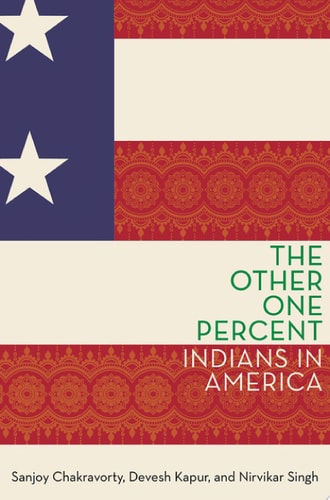
The Other One Percent: Indians in America
0
0
As an Amazon Associate and affiliate partner, Menrva Books earns from qualifying purchases. Learn more
Author Description
One of the most remarkable stories of immigration in the last half century is that of Indians to the United States. People of Indian origin make up a little over one percent of the American population now, up from barely half a percent at the turn of the millennium. Not only has its recent growth been extraordinary, but this population from a developing nation with low human capital is now the most-educated and highest-income group in the world's most advanced nation.The Other One Percent is a careful, data-driven, and comprehensive account of the three core processes-selection, assimilation, and entrepreneurship-that have led to this rapid rise. This unique phenomenon is driven by-and, in turn, has influenced-wide-ranging changes, especially the on-going revolution in information technology and its impact on economic globalization, immigration policies in the U.S., higher education policies in India, and foreign policies of both nations.If the overall picture is one of economic success, the details reveal the critical issues faced by Indian immigrants stemming from the social, linguistic, and class structure in India, their professional and geographic distribution in the U.S., their pan-Indian and regional identities, their strong presence in both high-skill industries (like computers and medicine) and low-skill industries (like hospitality and retail trade), and the multi-generational challenges of a diverse group from the world's largest democracy fitting into its oldest.
Menrva's Summary
THE THESIS
This book investigates the socio-economic mechanisms that enabled the Indian diaspora in the United States to become the highest-income and most-educated demographic group within a few decades. The authors, Devesh Kapur, Nirvikar Singh, and Sanjoy Chakravorty, utilize extensive demographic data and historical analysis to argue that the success of this group is rooted in specific selection processes, assimilation patterns, and high rates of entrepreneurship. Their framework connects these individual outcomes to broader shifts in global information technology, immigration policy, and the educational systems of both India and the United States.
THE SCOPE MAP
What You Will Find
- Analysis of the selection, assimilation, and entrepreneurship processes.
- Examination of professional distribution across high-skill and low-skill sectors.
- Discussion of the impact of U.S. immigration policy and Indian higher education.
Scope Limits
- The text focuses primarily on the economic and social integration of the Indian diaspora rather than individual biographical narratives.
- It does not provide an exhaustive cultural history of every regional sub-group within the Indian-American population.
THE AUTHORITY PERSPECTIVE
Experts recognize this work as a foundational, data-heavy analysis of contemporary migration patterns. Readers frequently note the academic density of the prose, which provides a rigorous examination of how a specific immigrant group navigates the economic landscape of the United States.
Page Count:
384
Publication Date:
2016-11-25
Publisher:
Oxford University Press
ISBN-10:
0190648740
ISBN-13:
9780190648749
History
Politics
Economics
Sociology
New Used & Rental Textbooks
Anthropology
World politics
Asian Studies
Systems Theory
Politics & Government
Cultural
Demography
Immigration
United States
Ethnic Studies
East Indians
Community Tags
Similar Books