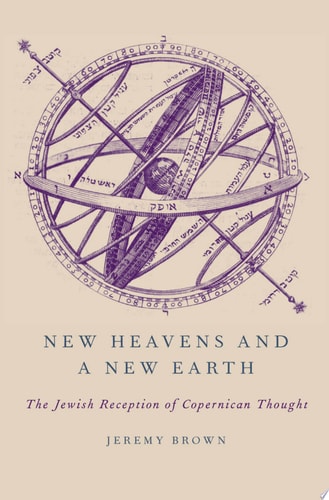
New Heavens and a New Earth: The Jewish Reception of Copernican Thought
0
0
As an Amazon Associate and affiliate partner, Menrva Books earns from qualifying purchases. Learn more
Author Description
In this ground-breaking study of the Jewish reception of the Copernican revolution, Jeremy Brown examines four hundred years of Jewish writings on the Copernican model. Brown shows the ways in which Jews ignored, rejected, or accepted the Copernican model, and the theological and societal underpinnings of their choices.Throughout New Heavens and a New Earth are deft historical studies of such colorful figures as Joseph Delmedigo, the first Jewish Copernican and a student of Galileo's; Tuviah Cohen, who called Copernicus the "Son of Satan;" Zelig Slonimski, author of a collection of essays on Halley's Comet; and contemporary Jewish thinkers who use Einstein's Theory of Relativity to argue that the Earth does not actually revolve around the sun. Brown also provides insightful comparisons of concurrent Jewish and Christian writings on Copernicus, demonstrating that the Jewish reception of Copernicus was largely dependent on local factors and responses.The book concludes with the important lessons to be learned from the history of the Jewish reception of Copernican thought, and shows how religions make room for new scientific descriptions of reality while upholding their most cherished beliefs.
Menrva's Summary
THE THESIS
This book investigates how Jewish thinkers across four centuries navigated the theological and societal challenges posed by the Copernican revolution. Jeremy Phillip Brown, a scholar of Jewish history and science, utilizes a broad range of primary texts to analyze the diverse reactions of Jewish intellectuals to heliocentrism. The work argues that the reception of Copernican thought was not a monolithic process but was instead shaped by local cultural contexts, individual theological commitments, and the evolving relationship between religious tradition and empirical observation.
THE SCOPE MAP
What You Will Find
- A four-hundred-year historical survey of Jewish writings regarding the Copernican model.
- Comparative analysis between Jewish and Christian intellectual responses to heliocentrism.
- Biographical studies of figures such as Joseph Delmedigo, Tuviah Cohen, and Zelig Slonimski.
- Examination of how religious frameworks adapt to accommodate or reject scientific descriptions of reality.
THE AUTHORITY PERSPECTIVE
Scholars and historians of science recognize this work as a comprehensive examination of a previously under-researched intersection of Jewish intellectual history and astronomy. Readers frequently note the academic rigor of the prose and the clarity with which Brown navigates complex theological debates.
Page Count:
416
Publication Date:
2013-05-31
Publisher:
Oxford University Press
ISBN-10:
0199754799
ISBN-13:
9780199754793
History
Philosophy
Science
Religion
Judaism
Jewish Studies
Astronomy
Community Tags
Similar Books