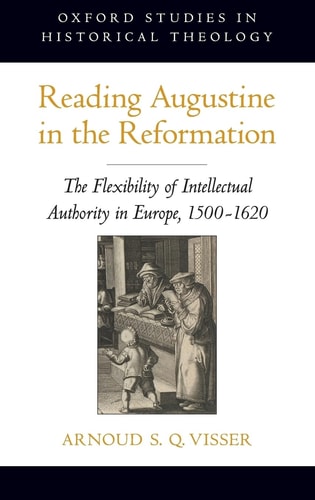
Reading Augustine in the Reformation: The Flexibility of Intellectual Authority in Europe, 1500-1620
0
0
As an Amazon Associate and affiliate partner, Menrva Books earns from qualifying purchases. Learn more
Author Description
In sixteenth-century Europe, Augustine was received as one of the most prominent religious and philosophical authorities, yet the various parties appropriated his thought in different, often contrasting ways. Augustine was claimed as a thoroughly Lutheran, Catholic, or Calvinist thinker, and even hailed as the ideal Erasmian pastor. These wildly contrasting receptions raise crucial questions about the significance of Augustine's thought in the Reformation period. They also show the complex relationship between religious change and the new intellectual culture of Renaissance humanism.Drawing on a variety of printed and manuscript sources, Arnoud Visser breaks new ground in three ways. He systematically grounds Augustine's theological reception in the history of reading and the material culture of books and manuscripts. He does not confine his examination to particular confessional parties or specific geographic boundaries, but offers a cross-confessional account of Augustine's appropriation in early modern Europe. Finally, he provides crucial insight into the nature of intellectual authority in the early modern period.Central in this study are the production, circulation and consumption of Augustine's works. Visser examines the impact of the new art of print, the rise of humanist scholarship, and the emerging confessional divisions on Augustine's reception. He shows how editors navigated a wealth of patristic information by using search tools and anthologies, and explains how individual readers used their copies and how they applied their knowledge in public debates. Reading Augustine in the Reformation argues that emerging confessional pressures did not restrict intellectual life, as has often been claimed, but promoted exciting new areas and modes of scholarship.
Menrva's Summary
THE THESIS
This study investigates how the reception of Augustine of Hippo functioned as a flexible instrument of intellectual authority across diverse confessional and cultural landscapes in early modern Europe. Arnoud S. Q. Visser, a scholar of early modern intellectual history, utilizes a broad array of primary sources, including printed editions and manuscript marginalia, to challenge the notion that confessional polarization stifled scholarly inquiry. He argues that the appropriation of Augustinian thought was not a monolithic process but a dynamic interaction between Renaissance humanist methodology and the emerging religious divisions of the sixteenth and early seventeenth centuries.
THE SCOPE MAP
What You Will Find
- Analysis of the production, circulation, and consumption of Augustinian texts between 1500 and 1620.
- Examination of the impact of print culture and humanist editorial practices on patristic scholarship.
- Cross-confessional comparison of how Lutheran, Catholic, Calvinist, and Erasmian thinkers claimed Augustine for their respective agendas.
- Investigation into the material culture of reading, including the use of indices, anthologies, and search tools in early modern libraries.
THE AUTHORITY PERSPECTIVE
Scholars recognize this work as a significant contribution to the history of reading and the study of patristic reception in the Reformation era. Experts frequently highlight the text's meticulous archival research and its ability to bridge the gap between theological history and the material history of the book.
Page Count:
256
Publication Date:
2011-05-11
Publisher:
Oxford University Press
ISBN-10:
0199765936
ISBN-13:
9780199765935
History
Philosophy
Theology
Intellectual History
Renaissance
Reformation
Community Tags
Similar Books