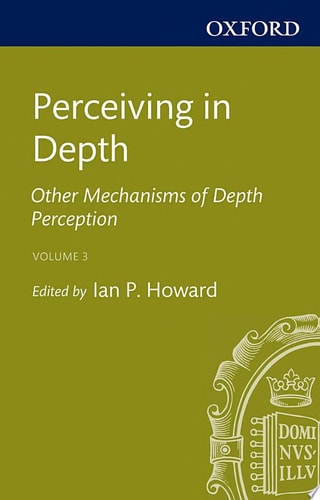
Perceiving in Depth, Volume 3: Other Mechanisms of Depth Perception
0
0
As an Amazon Associate and affiliate partner, Menrva Books earns from qualifying purchases. Learn more
Author Description
The three-volume work Perceiving in Depth is a sequel to Binocular Vision and Stereopsis and to Seeing in Depth, both by Ian P. Howard and Brian J. Rogers. This work is much broader in scope than the previous books and includes mechanisms of depth perception by all senses, including aural, electrosensory organs, and the somatosensory system. Volume 1 reviews sensory coding, psychophysical and analytic procedures, and basic visual mechanisms. Volume 2 reviews stereoscopic vision. Volume 3 reviews all mechanisms of depth perception other than stereoscopic vision. The three volumes are extensively illustrated and referenced and provide the most detailed review of all aspects of perceiving the three-dimensional world.Volume 3 addresses all depth-perception mechanisms other than stereopsis. The book starts with an account of monocular cues to depth, including accommodation, vergence eye movements, perspective, interposition, shading, and motion parallax. A chapter on constancies in depth perception, such as the ability to perceive the sizes and shapes of objects as they move or rotate in depth, is followed by a chapter on the ways in which depth cues interact. The next chapter reviews sources of information, such as changing disparity, image looming, and vergence eye movements, used in the perception of objects moving in depth. Various pathologies of depth perception, including visual neglect, stereoanomalies, and albanism are reviewed. Visual depth-perception mechanisms through the animal kingdom are described, starting with insects and progressing through crustaceans, fish, amphibians, reptiles, birds, and mammals. The chapter includes a discussion of how stereoscopic vision may have evolved. The next chapter describes how visual depth perception is used to guide reaching movements of the hand, avoiding obstacles, and walking to a distant object. The next three chapters review non-visual mechanisms of depth perception. Auditory mechanisms include auditory localization,
Menrva's Summary
THE THESIS
This volume investigates the diverse mechanisms of depth perception that function independently of stereoscopic vision. Author Ian P. Howard, a prominent researcher in visual perception, synthesizes extensive psychophysical data and biological research to explain how organisms perceive three-dimensional space. The text provides a comprehensive framework for understanding monocular cues, motion-based depth perception, and non-visual sensory systems across various species.
THE SCOPE MAP
What You Will Find
- Detailed analysis of monocular depth cues including accommodation, motion parallax, and perspective.
- Examination of depth perception pathologies such as visual neglect and stereoanomalies.
- Comparative biological study of depth perception mechanisms across the animal kingdom from insects to mammals.
- Review of non-visual depth perception systems including auditory localization and somatosensory processing.
THE AUTHORITY PERSPECTIVE
Experts recognize this work as a definitive, encyclopedic reference for researchers and students in the fields of sensory psychology and neuroscience. Readers frequently note the high academic density and the exhaustive nature of the citations provided throughout the text.
Page Count:
400
Publication Date:
2012-02-24
Publisher:
Oxford University Press
ISBN-10:
0199764166
ISBN-13:
9780199764167
Psychology
Science
Perception
Neuroscience
Biology
Community Tags
Similar Books