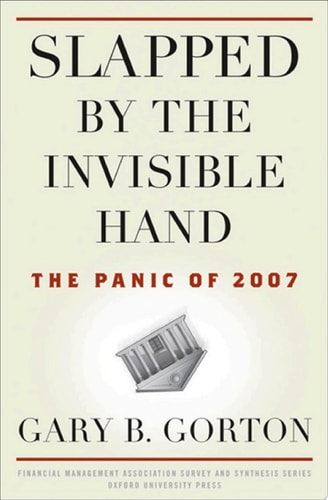
Slapped by the Invisible Hand: The Panic of 2007
0
0
As an Amazon Associate and affiliate partner, Menrva Books earns from qualifying purchases. Learn more
Author Description
Originally written for a conference of the Federal Reserve, Gary Gorton's "The Panic of 2007" garnered enormous attention and is considered by many to be the most convincing take on the recent economic meltdown. Now, in Slapped by the Invisible Hand, Gorton builds upon this seminal work, explaining how the securitized-banking system, the nexus of financial markets and instruments unknown to most people, stands at the heart of the financial crisis. Gorton shows that the Panic of 2007 was not so different from the Panics of 1907 or of 1893, except that, in 2007, most people had never heard of the markets that were involved, didn't know how they worked, or what their purposes were. Terms like subprime mortgage, asset-backed commercial paper conduit, structured investment vehicle, credit derivative, securitization, or repo market were meaningless. In this superb volume, Gorton makes all of this crystal clear. He shows that the securitized banking system is, in fact, a real banking system, allowing institutional investors and firms to make enormous, short-term deposits. But as any banking system, it was vulnerable to a panic. Indeed the events starting in August 2007 can best be understood not as a retail panic involving individuals, but as a wholesale panic involving institutions, where large financial firms "ran" on other financial firms, making the system insolvent. An authority on banking panics, Gorton is the ideal person to explain the financial calamity of 2007. Indeed, as the crisis unfolded, he was working inside an institution that played a central role in the collapse. Thus, this book presents the unparalleled and invaluable perspective of a top scholar who was also a key insider.
Menrva's Summary
THE THESIS
The book investigates the fundamental question of why the 2007 financial crisis occurred and how the securitized banking system functioned as a catalyst for a wholesale institutional panic. Gary B. Gorton, a scholar and industry insider, utilizes his expertise in banking history to draw parallels between the 2007 meltdown and historical panics of the 19th and early 20th centuries. He argues that the crisis was not a retail event but a systemic failure of the shadow banking sector, which operated without the traditional safeguards of retail banking. By demystifying complex financial instruments, Gorton provides a framework for understanding the structural vulnerabilities inherent in modern wholesale finance.
THE SCOPE MAP
What You Will Find
- Analysis of the securitized banking system and its operational mechanics.
- Historical comparison between the 2007 crisis and the panics of 1893 and 1907.
- Examination of institutional "runs" on financial firms and the resulting insolvency.
- Definitions and functional explanations of subprime mortgages, repo markets, and credit derivatives.
THE AUTHORITY PERSPECTIVE
Experts and economists frequently cite this work as a foundational text for understanding the mechanics of the shadow banking system. Readers often note the technical clarity Gorton brings to complex financial instruments, making the text accessible to those outside of specialized finance circles.
Page Count:
231
Publication Date:
2010-01-01
Publisher:
Oxford University Press
ISBN-10:
0199779511
ISBN-13:
9780199779512
Economics
Business
History
Banking
Money & BankingMonetary Theory
Finance
Community Tags
Similar Books