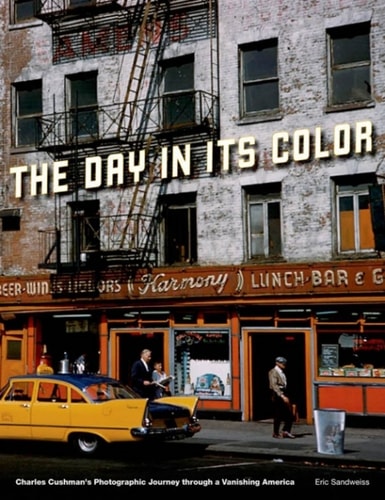
The Day in Its Color: Charles Cushman's Photographic Journey Through a Vanishing America
0
0
As an Amazon Associate and affiliate partner, Menrva Books earns from qualifying purchases. Learn more
Author Description
Charles Cushman (1896-1972) photographed a disappearing world in living color. Cushman's midcentury America--a place normally seen only through a scrim of gray--reveals itself as a place as vivid and real as the view through our window.The Day in Its Color introduces readers to Cushman's extraordinary work, a recently unearthed archive of photographs that is the largest known body of early color photographs by a single photographer, 14,500 in all, most shot on vivid, color-saturated Kodachrome stock. From 1938-1969, Cushman--a sometime businessman and amateur photographer with an uncanny eye for everyday detail--travelled constantly, shooting everything he encountered as he ventured from New York to New Orleans, Chicago to San Francisco, and everywhere in between. His photos include portraits, ethnographic studies, agricultural and industrial landscapes, movie sets and media events, children playing, laborers working, and thousands of street scenes, all precisely documented in time and place. The result is a chronicle of an era almost never seen, or even envisioned, in color. This well-preserved collection is all the more remarkable for having gone undiscovered for decades. What makes the photos most valuable, however, is the wide range of subjects, landscapes, and moods it captures--snapshots of a lost America as yet untouched by a homogenizing overlay of interstate highways, urban renewal, chain stores, and suburban development--a world of hand-painted signs, state fairs, ramshackle shops, small town living and bustling urban scenes. The book also reveals the fascinating and startling life story of the man who stood, unseen, on the other side of the lens, surely one of America's most impressive amateur photographers and outsider artists. With over 150 gorgeous color prints, The Day in Its Color gives us one of the most evocative visual histories of mid-20th century America that we have.
Menrva's Summary
THE THESIS
This work investigates the mid-20th-century American landscape through the lens of Charles Cushman, a prolific amateur photographer whose extensive color archive challenges the monochromatic perception of the era. Eric Sandweiss, a historian, utilizes this recently discovered collection of 14,500 Kodachrome images to reconstruct a visual history of the United States between 1938 and 1969. The book argues that Cushman’s work provides a unique, unfiltered record of a nation undergoing rapid transformation, capturing the transition from small-town life to the onset of modern suburbanization. By pairing these images with biographical context, the author examines how an outsider artist documented the mundane and the monumental with equal precision.
THE SCOPE MAP
What You Will Find
- A comprehensive analysis of 14,500 Kodachrome photographs spanning three decades of American life.
- Biographical insights into the life and motivations of Charles Cushman, an amateur photographer and businessman.
- A visual survey of diverse subjects including industrial landscapes, ethnographic studies, and daily street scenes.
- Contextual examination of mid-century American culture prior to the homogenizing effects of urban renewal and interstate development.
THE AUTHORITY PERSPECTIVE
Critics and historians recognize this volume as a significant contribution to the visual record of mid-century America, praising the clarity and saturation of the reproduced Kodachrome prints. Scholars frequently highlight the book's value in providing a rare, color-saturated perspective on a period typically archived in black and white.
Page Count:
240
Publication Date:
2013-01-01
Publisher:
Oxford University Press
ISBN-10:
0199773092
ISBN-13:
9780199773091
Photography
Biography
History
Photographers biography
Visual Arts
Art History
American History
American Art
Color
Humanities
Community Tags
Similar Books