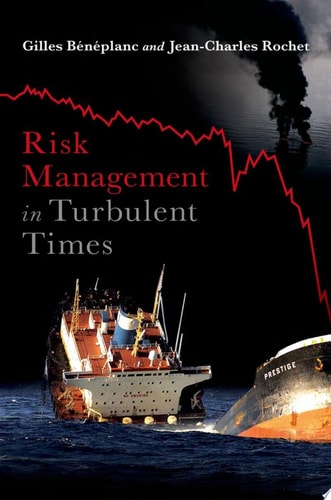
Risk Management in Turbulent Times
0
0
As an Amazon Associate and affiliate partner, Menrva Books earns from qualifying purchases. Learn more
Author Description
The Subprime Crisis Has Shown That The Sophisticated Risk Management Models Used By Banks And Insurance Companies Had Serious Flaws. Some People Even Suggest That These Models Are Completely Useless. Others Claim That The Crisis Was Just An Unpredictable Accident That Was Largely Amplified By The Lack Of Expertise And Even Naivety Of Many Investors. This Book Takes The Middle View. It Shows That These Models Have Been Designed For Tranquil Times, When Financial Markets Behave Smoothly And Efficiently. However, We Are Living In More And More Turbulent Times: Large Risks Materialize Much More Often Than Predicted By Normal Models, Financial Models Periodically Go Through Bubbles And Crashes. Moreover, Financial Risks Result From The Decisions Of Economic Actors Who Can Have Incentives To Take Excessive Risks, Especially When Their Remunerations Are Ill Designed. The Book Provides A Clear Account Of The Fundamental Hypotheses Underlying The Most Popular Models Of Risk Management And Show That These Hypotheses Are Flawed. However It Shows That Simple Models Can Still Be Useful, Provided They Are Well Understood And Used With Caution.
Menrva's Summary
THE THESIS
This book investigates the fundamental limitations of traditional financial risk management models when applied to volatile, non-linear market environments. The authors, Gilles Béné and Jean-Charles Rochet, leverage their expertise in financial economics to critique the reliance on models designed for stable conditions. They argue that while current risk frameworks are inherently flawed due to their reliance on normal distribution assumptions, they remain functional tools if practitioners acknowledge their constraints and the behavioral incentives of market participants.
THE SCOPE MAP
What You Will Find
- Analysis of the failure of sophisticated risk models during the subprime mortgage crisis.
- Examination of the disconnect between theoretical market efficiency and the reality of bubbles and crashes.
- Discussion on how incentive structures and remuneration policies influence excessive risk-taking by economic actors.
- A framework for applying simplified risk models with appropriate caution and contextual awareness.
THE AUTHORITY PERSPECTIVE
Experts frequently cite this work as a balanced critique that bridges the gap between academic theory and practical financial application. Readers often note the clarity with which the authors explain complex mathematical hypotheses for a professional audience.
Page Count:
256
Publication Date:
2011-01-01
Publisher:
Oxford University Press, Incorporated
ISBN-10:
0199774218
ISBN-13:
9780199774210
Business
Economics
Finance
Banking
Community Tags
Similar Books