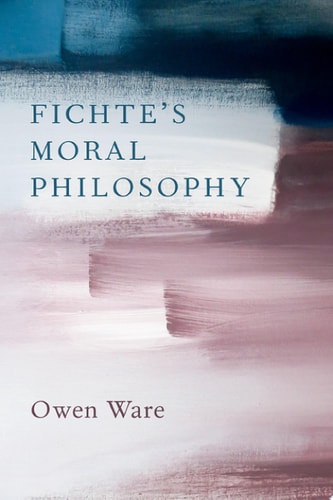
Fichte's Moral Philosophy
0
0
As an Amazon Associate and affiliate partner, Menrva Books earns from qualifying purchases. Learn more
Author Description
Owen Ware here develops and defends a novel interpretation of Fichte's moral philosophy as an ethics of wholeness. While virtually forgotten for most of the twentieth century, Fichte's System of Ethics (1798) is now recognized by scholars as a masterpiece in the history of post-Kantian philosophy, as well as a key text for understanding the work of later German idealist thinkers. This book provides a careful examination of the intellectual context in which Fichte's moral philosophy evolved, and of the specific arguments he offers in response to Kant and his immediate successors. A distinctive feature of this study is a focus on the foundational concepts of Fichte's ethics--freedom, morality, feeling, conscience, community--and their connection to his innovative but largely misunderstood theory of drives. By way of conclusion, the book shows that what appears to be two conflicting commitments in Fichte's ethics--a commitment to the feelings of one's conscience and a commitment to engage in open dialogue with others--are two aspects of his theory of moral perfection. The result is a sharp understanding of Fichte's System of Ethics as offering a compelling resolution to the personal and interpersonal dimensions of moral life
Menrva's Summary
THE THESIS
This book investigates the core question of whether Fichte's moral philosophy can be interpreted as a coherent ethics of wholeness that resolves tensions between individual conscience and interpersonal dialogue. Owen Ware, a scholar of German Idealism, utilizes historical context and textual analysis of Fichte's 1798 System of Ethics to challenge long-standing misinterpretations of the philosopher's work. By situating Fichte within the post-Kantian tradition, Ware argues that Fichte's theory of drives provides a necessary foundation for understanding his broader moral framework.
THE SCOPE MAP
What You Will Find
- A detailed analysis of Fichte's System of Ethics (1798).
- An examination of the intellectual evolution of Fichte's moral arguments in response to Kant.
- A systematic breakdown of foundational concepts including freedom, morality, feeling, conscience, and community.
- A synthesis of Fichte's theory of drives and its role in moral perfection.
Scope Limits
- The text does not provide a general biography of Fichte outside of his philosophical development.
- It does not offer a comprehensive survey of all German Idealist thinkers, focusing primarily on Fichte's specific contributions.
THE AUTHORITY PERSPECTIVE
Scholars recognize this work as a significant contribution to the re-evaluation of Fichte's place in the history of philosophy. Readers frequently note the academic density of the prose, which is intended for those already familiar with the complexities of post-Kantian thought.
Page Count:
262
Publication Date:
2020-01-01
Publisher:
Oxford University Press
ISBN-10:
0190086610
ISBN-13:
9780190086619
Philosophy
Academic
History & Surveys
Ethics
Philosophy history
Community Tags
Similar Books