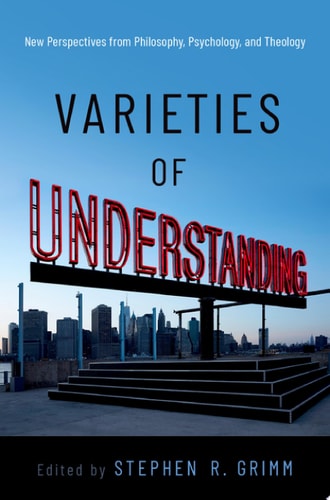
Varieties of Understanding: New Perspectives from Philosophy, Psychology, and Theology
0
0
As an Amazon Associate and affiliate partner, Menrva Books earns from qualifying purchases. Learn more
Author Description
What does it mean to understand something? What is the essence of understanding, when compared across multiple domains? Varieties of Understanding offers new and original work on the nature of understanding, raising questions about what understanding looks like from different perspectives and exploring how ordinary people use the notion of understanding. According to a long historical tradition, understanding comes in different varieties. In particular, it is said that understanding people has a different epistemic profile than understanding the natural world-that it calls on different cognitive resources and brings to bear distinctive normative considerations. Thus, in order to understand people we might need to appreciate, or in some way sympathetically reconstruct, the reasons that led a person to act in a certain way. By comparison, when it comes to understanding natural events, like earthquakes or eclipses, no appreciation of reasons or acts of sympathetic reconstruction is arguably needed-mainly because there are no reasons on the scene to even be appreciated, and no perspectives to be sympathetically pieced together.This volume brings together some of the world's leading philosophers, psychologists, and theologians in order to shed light on the various ways in which we understand the world, pushing debates on this issue to new levels of sophistication and insight.
Menrva's Summary
THE THESIS
This volume investigates the fundamental nature of understanding by examining how the concept functions across the distinct domains of philosophy, psychology, and theology. Editor Stephen R. Grimm compiles original contributions from leading scholars to analyze whether understanding the natural world requires different cognitive resources than understanding human behavior. The text argues that while natural phenomena may be explained through causal mechanisms, understanding human action necessitates a form of sympathetic reconstruction of reasons.
THE SCOPE MAP
What You Will Find
- Comparative analysis of epistemic profiles in natural versus human sciences
- Theoretical frameworks regarding the role of normative considerations in cognition
- Interdisciplinary perspectives on the cognitive resources required for social understanding
- Empirical and philosophical inquiries into how ordinary individuals utilize the concept of understanding
Scope Limits
- The text does not provide a singular, unified definition of understanding applicable to all fields
- It does not offer a practical guide for improving personal comprehension skills
THE AUTHORITY PERSPECTIVE
Scholars and students of epistemology frequently cite this collection as a significant resource for bridging the gap between analytical philosophy and cognitive psychology. Experts note that the academic density of the prose makes it most suitable for advanced researchers and graduate-level study in the humanities.
Page Count:
300
Publication Date:
2019-09-19
Publisher:
Oxford University Press
ISBN-10:
0190860979
ISBN-13:
9780190860974
Philosophy
Politics
Psychology
Epistemology
New Used & Rental Textbooks
Consciousness & Thought
Mind & Body
Academic
Theology
Community Tags
Similar Books