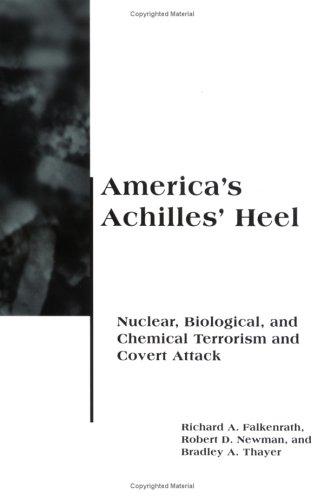
America's Achilles' Heel
0
0
As an Amazon Associate and affiliate partner, Menrva Books earns from qualifying purchases. Learn more
Author Description
This book focuses on the vulnerability of all open societies to loss of life from the covert or terrorist delivery of nuclear, biological, or chemical weapons. The passing of the Soviet threat has changed the nature of the mass-destruction threat to U.S. cities, making it necessary to update the strategic assumptions of defense policy. Nuclear, biological, and chemical (NBC) weapons share three characteristics: immense lethality, portability, and accessibility. A covert NBC attack could be carried out in peacetime or during war, and could target civilians, military forces, or infrastructure. The defining element of a covert attack is that the weapon is delivered against its target in a manner that cannot readily be distinguished from normal background traffic and activity. A covert NBC attack against the United States is a quintessential low-probability, high-consequence event. However, it is growing greater with time for three key reasons. These weapons are becoming more accessible to a wider range of groups. The predominance of military forces and the virtual invulnerability of the homeland to direct military attack leave international adversaries with few options other than unconventional threats. The nature of nonstate violence is changing in a way that strongly suggests risking NBC risks. The consequences of covert NBC attacks and terrorism are massive casualties, contamination, panic, degraded response capabilities, economic damage, loss of strategic position, and social-psychological damage and political change. Recommendations to reduce the vulnerability of the United States included establishing an NBC response center; reinvigorating the intelligence community, improving the detection of small-scale NBC weapons programs; and improving capability for post-attack attribution.
Menrva's Summary
THE THESIS
The United States faces a growing and underestimated threat from the covert delivery of nuclear, biological, or chemical (NBC) weapons by terrorists or rogue states. The end of the Cold War has shifted the nature of this danger, making it imperative to re-evaluate defense policy assumptions, as these weapons are increasingly accessible, portable, and lethally potent. A covert NBC attack, characterized by its indistinguishable delivery amidst normal activity, represents a low-probability but high-consequence event that demands urgent attention and updated strategic thinking to mitigate catastrophic outcomes.
THE SCOPE MAP
- Analysis of the characteristics of NBC weapons: immense lethality, portability, and accessibility.
- Examination of the evolving nature of the mass-destruction threat to U.S. cities post-Soviet era.
- Discussion of the defining element of a covert attack: delivery indistinguishable from normal activity.
- Assessment of the growing accessibility of NBC weapons to a wider range of groups.
- Exploration of the limited options for international adversaries against a militarily dominant U.S. homeland.
- Recommendations for reducing U.S. vulnerability, including establishing an NBC response center and improving intelligence.
- Consideration of the massive casualties, contamination, panic, and economic/social damage resulting from covert NBC attacks.
THE AUTHORITY PERSPECTIVE
The book posits that open societies are uniquely vulnerable to the covert delivery of NBC weapons, a threat that has evolved significantly with the passing of the Soviet threat. It argues that the increasing accessibility of these weapons and the limited options for adversaries necessitate a reassessment of U.S. defense policy. The author proposes specific recommendations, such as establishing an NBC response center and enhancing intelligence capabilities, to mitigate the catastrophic potential of such attacks. The analysis highlights the low-probability, high-consequence nature of covert NBC attacks and their profound societal impacts.
Page Count:
354
Publication Date:
1998-01-01
ISBN-10:
0262561182
Science
Non-Fiction
Politics
National security
International relations
Public Health
Community Tags
Similar Books