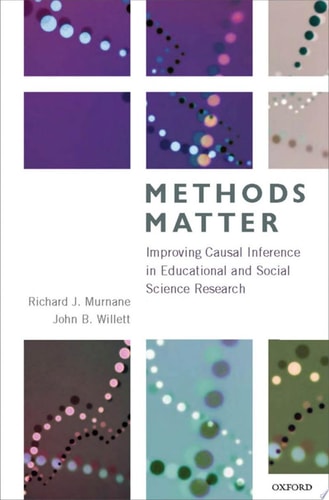
Methods Matter: Improving Causal Inference in Educational and Social Science Research
0
0
As an Amazon Associate and affiliate partner, Menrva Books earns from qualifying purchases. Learn more
Author Description
Educational Policy-makers Around The World Constantly Make Decisions About How To Use Scarce Resources To Improve The Education Of Children. Unfortunately, Their Decisions Are Rarely Informed By Evidence On The Consequences Of These Initiatives In Other Settings. Nor Are Decisions Typically Accompanied By Well-formulated Plans To Evaluate Their Causal Impacts. As A Result, Knowledge About What Works In Different Situations Has Been Very Slow To Accumulate. Over The Last Several Decades, Advances In Research Methodology, Administrative Record Keeping, And Statistical Software Have Dramatically Increased The Potential For Researchers To Conduct Compelling Evaluations Of The Causal Impacts Of Educational Interventions, And The Number Of Well-designed Studies Is Growing. Written In Clear, Concise Prose, Methods Matter: Improving Causal Inference In Educational And Social Science Research Offers Essential Guidance For Those Who Evaluate Educational Policies. Using Numerous Examples Of High-quality Studies That Have Evaluated The Causal Impacts Of Important Educational Interventions, The Authors Go Beyond The Simple Presentation Of New Analytical Methods To Discuss The Controversies Surrounding Each Study, And Provide Heuristic Explanations That Are Also Broadly Accessible. Murnane And Willett Offer Strong Methodological Insights On Causal Inference, While Also Examining The Consequences Of A Wide Variety Of Educational Policies Implemented In The U.s. And Abroad. Representing A Unique Contribution To The Literature Surrounding Educational Research, This Landmark Text Will Be Invaluable For Students And Researchers In Education And Public Policy, As Well As Those Interested In Social Science.
Menrva's Summary
THE THESIS
This book investigates how researchers and policy-makers can improve the quality of causal inference in educational and social science research to better inform resource allocation. John B. Willett and Richard J. Murnane, both established scholars in education and policy, synthesize decades of methodological advancements to provide a framework for evaluating the impact of interventions. They argue that by integrating rigorous statistical techniques with administrative data, researchers can overcome the historical stagnation in understanding what educational policies actually produce results. The text serves as a bridge between complex statistical theory and the practical application of policy evaluation in real-world settings.
THE SCOPE MAP
What You Will Find
- Methodological frameworks for evaluating the causal impacts of educational interventions.
- Heuristic explanations of complex statistical models and analytical techniques.
- Case studies of high-quality research conducted in the United States and abroad.
- Guidance on navigating the controversies and limitations inherent in social science data collection.
THE AUTHORITY PERSPECTIVE
Experts and academics frequently cite this work as a foundational text for students and practitioners navigating the intersection of policy and quantitative research. Readers often note that the prose remains accessible despite the technical density of the subject matter, making it a standard reference for those conducting empirical studies in education.
Page Count:
397
Publication Date:
2010-01-01
Publisher:
Oxford University Press
ISBN-10:
0199780315
ISBN-13:
9780199780310
Public Policy
Reference
Education
Statistics
Schools & Teaching
Education Theory
Linguistics
Kindle eBooks
Kindle Store
Education & Training
Words Language & Grammar
Categories
Social Science
Community Tags
Similar Books