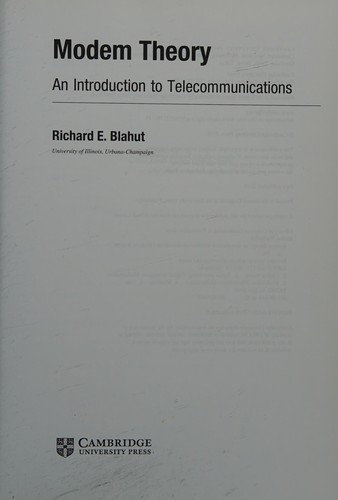
Modem Theory
0
0
As an Amazon Associate and affiliate partner, Menrva Books earns from qualifying purchases. Learn more
Author Description
At the heart of any modern communication system is the modem, connecting the data source to the communication channel. This first course in the mathematical theory of modem design introduces the theory of digital modulation and coding that underpins the design of digital telecommunications systems. A detailed treatment of core subjects is provided, including baseband and passband modulation and demodulation, equalization, and sequence estimation. The modulation waveforms for communication channels and digital recording channels are treated in a common setting and with unified terminology. A variety of more advanced topics is also covered, such as trellis codes, turbo codes, the Viterbi algorithm, block codes, maximum likelihood and maximum posterior probability, iterative demodulation, and jamming. Numerous end-of-chapter exercises are also included to test the reader's understanding throughout. This insightful book is ideal for senior undergraduate students studying digital communications and is also a useful reference for practicing engineers
Menrva's Summary
THE THESIS
The design of modern communication systems hinges on the modem, the critical interface between data and channel. This book introduces the mathematical theory behind modem design, focusing on digital modulation and coding essential for digital telecommunications. It covers fundamental topics such as baseband and passband modulation/demodulation, equalization, and sequence estimation, unifying the treatment of communication and digital recording channels. Advanced subjects like trellis codes, turbo codes, the Viterbi algorithm, block codes, and iterative demodulation are also explored.
THE SCOPE MAP
- Detailed treatment of baseband and passband modulation and demodulation.
- Coverage of equalization and sequence estimation techniques.
- Unified approach to modulation waveforms for communication and digital recording channels.
- Exploration of advanced topics including trellis codes, turbo codes, and the Viterbi algorithm.
- Discussion of block codes, maximum likelihood, and maximum posterior probability.
- Inclusion of iterative demodulation and jamming.
- Numerous end-of-chapter exercises for reader comprehension.
THE AUTHORITY PERSPECTIVE
This book is presented as an ideal text for senior undergraduate students in digital communications and a valuable reference for practicing engineers. The publisher's description highlights its detailed treatment of core subjects and advanced topics, suggesting it aims to provide a comprehensive understanding of modem theory. The inclusion of numerous exercises indicates a pedagogical approach designed to reinforce learning. The unified terminology and common setting for different channel types suggest a rigorous and systematic presentation of the material.
Page Count:
497
Publication Date:
2010-01-01
ISBN-10:
0521780144
ISBN-13:
9780521780148
Science & Technology
Non-Fiction
Science
Engineering
Telecommunications
Community Tags
Similar Books