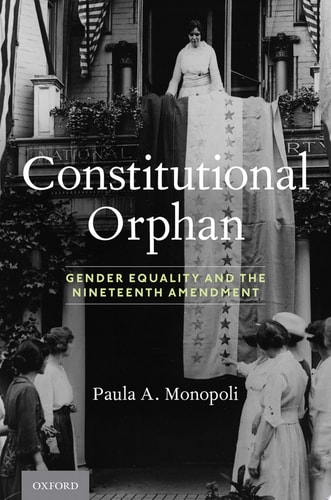
Constitutional Orphan
0
0
As an Amazon Associate and affiliate partner, Menrva Books earns from qualifying purchases. Learn more
Author Description
An Account Of The Ramifications Of The Passage Of The Nineteenth Amendment And The Divisions It Created In The Courts And Congress, And In The Women's Movement Itself. Constitutional Orphan Explores The Role Of Former Suffragists In The Constitutional Development Of The Nineteenth Amendment, During The Decade Following Its Ratification In 1920. It Examines The Pivot To New Missions, Immediately After Ratification, By Two National Suffrage Organizations, The National Woman's Party And The National American Woman Suffrage Association. The Nwp Turned From Suffrage To A Federal Equal Rights Amendment. Nawsa Became The National League Of Women Voters, And Turned To Voter Education And Social Welfare Legislation. The Book Then Connects That Pivot By Both Groups, To The Emergence Of A Thin Conception Of The Nineteenth Amendment, As A Matter Of Constitutional Interpretation. It Surfaces The History Around The Congressional Failure To Enact Enforcement Legislation, Pursuant To The Nineteenth, And Connects That With The Nwp's Perceived Need For Southern Congressional Votes For The Era. It Also Explores The Choice To Turn Away From African American Women Suffragists Asking For Help To Combat Voter Suppression Efforts, After The November 1920 Presidential Election; And Then Evaluates The Deep Divisions Among Nwp Members, Some Of Whom Were Social Feminists Who Opposed The Era, And The Nlwv, Which Supported The Social Feminists In That Opposition. The Book Also Analyzes How State Courts, Left Without Federal Enforcement Legislation To Constrain Or Guide Them, Used Strict Construction To Cabin The Emergence Of A More Robust Interpretation Of The Nineteenth. It Concludes With An Examination Of New Legal Scholarship, Which Suggests Broader Ways In Which The Nineteenth Could Be Used Today To Expand Gender Equality.
Menrva's Summary
THE THESIS
This book investigates the legal and political consequences of the Nineteenth Amendment's ratification, specifically focusing on why it failed to become a robust tool for gender equality. Paula A. Monopoli, a professor of law, utilizes historical records and legal analysis to argue that the immediate post-ratification pivot of major suffrage organizations, combined with a lack of federal enforcement legislation, resulted in a narrow judicial interpretation of the amendment. The text examines how internal divisions within the women's movement and strategic political choices contributed to the amendment's status as a constitutional orphan.
THE SCOPE MAP
What You Will Find
- Analysis of the post-1920 strategies of the National Woman's Party and the National American Woman Suffrage Association.
- Examination of the legislative failure to enact federal enforcement mechanisms for the Nineteenth Amendment.
- Evaluation of state court decisions that utilized strict construction to limit the amendment's scope.
- Review of contemporary legal scholarship proposing new applications for the Nineteenth Amendment.
Scope Limits
- The analysis is primarily confined to the decade immediately following the 1920 ratification.
- The text does not provide a comprehensive biography of individual suffragists, focusing instead on organizational and institutional outcomes.
THE AUTHORITY PERSPECTIVE
Legal scholars and historians recognize this work as a critical intervention in constitutional history that clarifies the institutional reasons for the Nineteenth Amendment's limited impact. Readers frequently note the academic density of the prose, which provides a rigorous examination of early twentieth-century legal and political maneuvering.
Page Count:
192
Publication Date:
2020-01-01
Publisher:
Oxford University Press
ISBN-10:
0190092807
ISBN-13:
9780190092801
History
Womens Studies
Law
American History
Constitutional Law
Community Tags
Similar Books