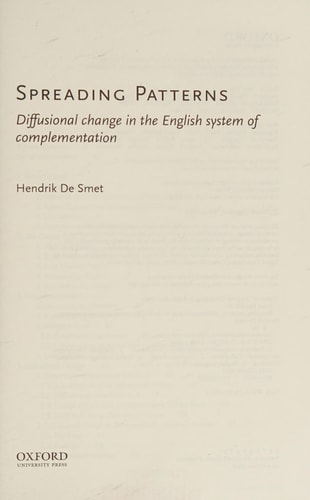
Spreading Patterns: Diffusional Change in the English System of Complementation
0
0
As an Amazon Associate and affiliate partner, Menrva Books earns from qualifying purchases. Learn more
Author Description
Spreading Patterns examines how new constructions emerge and spread through the grammar of a language, in a process called "diffusion". This is done by tracking the development of three types of complements from the Middle English period to the present day. These are subject-controlled gerund complements, for…to-infinitives, and subject-controlled participial complements. In the first half of the book, De Smet focuses on how and why patterns diffuse. In the second half, which is largely corpus-based, De Smet tests his theoretical model of diffusion on the three complement types. His work demonstrates how diffusion interacts with the grammatical system of complementation, how diffusion proceeds, step-by-step, and why diffusion is directional.Spreading Patterns will appeal to scholars and advanced students of English, history of English, and historical linguistics.
Menrva's Summary
THE THESIS
This book investigates the mechanisms of linguistic diffusion and how new grammatical constructions emerge and propagate within the English language system. Hendrik De Smet utilizes a rigorous theoretical framework to analyze the evolution of specific complementation structures from the Middle English period to the modern era. By integrating corpus-based data with historical analysis, the author provides a systematic explanation for the directionality and step-by-step progression of grammatical change.
THE SCOPE MAP
What You Will Find
- Analysis of subject-controlled gerund complements, for-to-infinitives, and subject-controlled participial complements
- A theoretical model explaining the diffusion of grammatical patterns
- Empirical evidence derived from extensive historical corpus data
- Examination of the interaction between diffusion processes and the broader grammatical system
THE AUTHORITY PERSPECTIVE
Scholars in historical linguistics recognize this work as a significant contribution to the study of syntactic change and the mechanics of language evolution. Readers frequently note the academic density of the prose and the precision of the corpus-based methodology employed by the author.
Page Count:
304
Publication Date:
2012-12-14
Publisher:
Oxford University Press
ISBN-10:
0199812756
ISBN-13:
9780199812752
Historical linguistics
Academic
Grammar
Linguistics
Community Tags
Similar Books