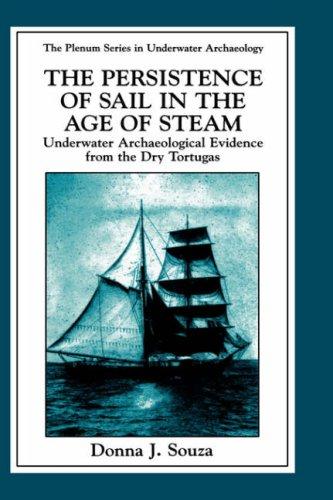
The Persistence of Sail in the Age of Steam
0
0
As an Amazon Associate and affiliate partner, Menrva Books earns from qualifying purchases. Learn more
Author Description
Synonymous with shipwrecks for centuries, the well-traveled waters surrounding the Dry Tortugas provide archaeologists with a large number of sites excellent for underwater investigation. Among them are six sailing ships, dating from the mid- to late-nineteenth century, that are of only minor interest when viewed historically. Considered anthropologically, however, they are a window onto the adaptability of an industry struggling with obsolescence. Focusing on the Pulaski Site, of which she was the principal investigator, Souza shows how merchant sailing attempted to compete with steamships through technological adaptation. Rich assemblages of deck machinery and related hardware provide numerous examples of specialized skills, developed over centuries, being brought to bear against the threat of superior technology. More surprising, however, are results indicating adaptive changes in behavior - namely, increased risk-taking. Souza addresses the issue in depth by outlining the factor of risk and risk-taking behavior, identifying the archaeological signatures of this behavior, and documenting the specific evidence for it. The result is not just a valuable contribution to our understanding of the maritime past, but also a work with broad applications to the study of cultural change and a model for a new kind of underwater archaeology. Professionals and students with a special interest in underwater archaeology, historical archaeology, maritime history, or cultural resource management will find this book to be of great use.
Menrva's Summary
THE THESIS
The Dry Tortugas' waters, notorious for shipwrecks, offer a unique archaeological laboratory for examining the twilight of sail. Focusing on the Pulaski Site, this book investigates how 19th-century merchant sailing ships adapted technologically and behaviorally to compete with the rising steamship industry. The research details the specialized skills and increased risk-taking employed by sailors as they faced obsolescence. This study provides insights into cultural change and a new model for underwater archaeology.
THE SCOPE MAP
- Analysis of six sailing ships from the mid
- to late-nineteenth century found in the Dry Tortugas.
- In-depth focus on the Pulaski Site, with Souza as principal investigator.
- Examination of deck machinery and hardware as evidence of technological adaptation.
- Documentation of adaptive behavioral changes, specifically increased risk-taking.
- Methodology for identifying archaeological signatures of risk-taking behavior.
- Application of findings to the broader study of cultural change.
- A model for a new approach to underwater archaeology.
THE AUTHORITY PERSPECTIVE
This work is recognized as a valuable contribution to understanding the maritime past, particularly the challenges faced by sailing vessels in the age of steam. Its detailed archaeological analysis of the Pulaski Site and its findings on technological and behavioral adaptation are noted. The book is considered particularly useful for professionals and students in underwater archaeology, historical archaeology, maritime history, and cultural resource management. Its broader implications for the study of cultural change and its innovative approach to underwater archaeology are also highlighted.
Page Count:
189
Publication Date:
1998-01-01
ISBN-10:
0306458438
ISBN-13:
9780306458439
Non-Fiction
History
Maritime history
Industrial history
Archaeology
Community Tags
Similar Books