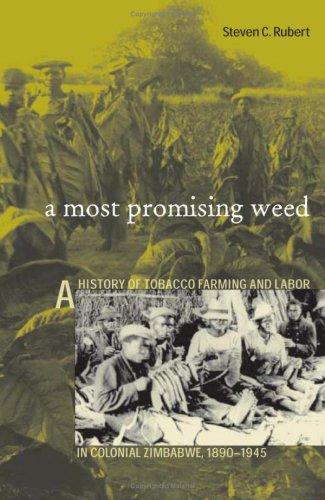
A Most Promising Weed
0
0
As an Amazon Associate and affiliate partner, Menrva Books earns from qualifying purchases. Learn more
Author Description
Thousands of African men, women, and children worked on European-owned tobacco farms in colonial Zimbabwe from 1890 to 1945. Contrary to some commonly held notions, these people were not mere bystanders as European capitalism penetrated into Zimbabwe, but helped to shape the work and the living conditions they encountered as they entered wage employment. Steven Rubert's fine study draws on a rich variety of sources to illuminate the lives of these workers. The central focus of the study is the organization of workers' compounds, the social relationships there, and the labor of women and children, paid and unpaid. Rubert's findings indicate the beginnings of a moral economy on the tobacco farms prior to 1945.
Menrva's Summary
THE THESIS
This study investigates the complex roles of African men, women, and children on European-owned tobacco farms in colonial Zimbabwe between 1890 and 1945. It challenges the notion of them as passive participants, instead highlighting their agency in shaping work and living conditions within the emerging capitalist system. The research focuses on the organization of workers' compounds, the social dynamics within them, and the labor contributions of women and children, both paid and unpaid.
THE SCOPE MAP
- Analysis of African labor on European tobacco farms in colonial Zimbabwe (1890-1945).
- Examination of the organization and social relationships within workers' compounds.
- Focus on the labor of women and children, including paid and unpaid work.
- Exploration of the development of a 'moral economy' on these farms prior to 1945.
- Utilizes a rich variety of sources to illuminate the lives of the workers.
THE AUTHORITY PERSPECTIVE
This study is recognized for its detailed examination of labor and social conditions on colonial Zimbabwean tobacco farms. It is noted for drawing on a diverse range of sources to provide a nuanced perspective on the agency of African workers. The research highlights the significant contributions of women and children to the farm economy and social structures. The findings suggest the emergence of a distinct 'moral economy' within these compounds before 1945.
Page Count:
255
Publication Date:
1998-01-01
ISBN-10:
0896802035
History
Non-Fiction
African history
Social History
Labor history
Community Tags
Similar Books