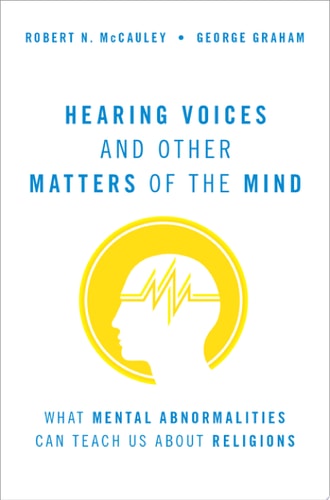
Hearing Voices and Other Matters of the Mind: What Mental Abnormalities Can Teach Us About Religions
0
0
As an Amazon Associate and affiliate partner, Menrva Books earns from qualifying purchases. Learn more
Author Description
A man with schizophrenia believes that God is instructing him through the public address system in a bus station. A nun falls into a decades-long depression because she believes that God refuses to answer her prayers. A neighborhood parishioner is bedeviled with anxiety because he believes that a certain religious ritual must be repeated, repeated, and repeated lest God punish him. To what extent are such manifestations of religious thinking analogous to mental disorder? Does mental dysfunction bring an individual closer to religious experience or thought? Hearing Voices and Other Unusual Experiences explores these questions using the tools of the cognitive science of religion and the philosophy of psychopathology.Robert McCauley and George Graham emphasize underlying cognitive continuities between familiar features of religiosity, of mental disorders, and of everyday thinking and action. They contend that much religious thought and behavior can be explained as the cultural activation of our natural cognitive systems, which address matters that are essential to human survival: hazard precautions, agency detection, language processing, and theory of mind. Those systems produce responses to cultural stimuli that may mimic features of cognition and conduct associated with mental disorders, but which are sometimes coded as "religious" depending on the context.The authors examine hallucinations of the voice of God and of other supernatural agents, spiritual depression often described as a "dark night of the soul," religious scrupulosity and compulsiveness, and challenges to theistic cognition that Autistic Spectrum Disorder poses. Their approach promises to shed light on both mental abnormalities and religiosity.
Menrva's Summary
THE THESIS
This book investigates the extent to which religious experiences and behaviors are analogous to symptoms of mental disorders by examining the cognitive mechanisms underlying both. Robert N. McCauley and George Graham, both established scholars in philosophy and cognitive science, utilize a framework rooted in the cognitive science of religion to argue that religious thought often stems from the activation of natural, survival-oriented cognitive systems. They posit that these systems, when triggered by cultural stimuli, produce responses that mirror mental dysfunction but are interpreted through a religious lens.
THE SCOPE MAP
What You Will Find
- Analysis of cognitive systems including agency detection, hazard precautions, and theory of mind.
- Examination of specific phenomena such as auditory hallucinations, spiritual depression, and religious scrupulosity.
- Application of philosophical psychopathology to religious case studies.
Scope Limits
- The text does not provide clinical diagnostic criteria for mental health professionals.
- It does not attempt to validate or invalidate the theological truth claims of any specific religious tradition.
THE AUTHORITY PERSPECTIVE
Experts in the cognitive science of religion identify this work as a significant contribution to the interdisciplinary study of human belief systems. Readers frequently note the academic density of the prose, which requires a foundational understanding of both cognitive science and philosophical terminology.
Page Count:
274
Publication Date:
2020-01-01
Publisher:
Oxford University Press
ISBN-10:
0190091169
ISBN-13:
9780190091163
Philosophy
Psychology
Religion
Allied Health
Cultural Anthropology
Sociology
Medical
Mind & Body
Community Tags
Similar Books