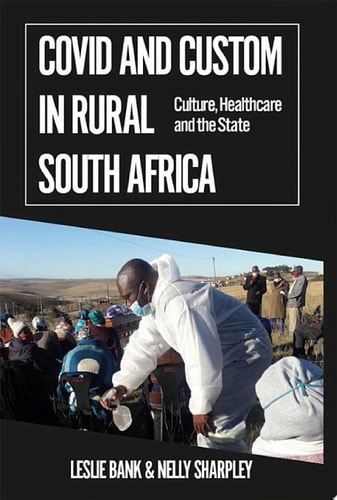
Covid and Custom in Rural South Africa: Culture, Healthcare and the State
0
0
As an Amazon Associate and affiliate partner, Menrva Books earns from qualifying purchases. Learn more
Author Description
This book explores the impact of Covid-19, and the associated state lockdown, on rural lives in a former homeland in South Africa. The 2020 Disaster Management Act saw the state sweep through rural areas, targeting funerals and other customary practices as potential "super-spreader" events. This unprecedented clampdown produced widespread disruption, fear and anxiety. The authors build on path-breaking work concerning local responses to West Africa's Ebola epidemic, and examine the HIV/AIDS pandemic, to understand the impact of the Covid crisis on these communities, and on rural Africa more broadly.To shed light on the role of custom and ritual in rural social change during the pandemic, Covid and Custom in Rural South Africa applies long-term historical and ethnographic research; theories of people's science, local knowledge and the human economy; and fieldwork conducted in ten rural South African communities during lockdown. The volume highlights differences between developments in Southern Africa and elsewhere on the continent, while exploring how the former apartheid homelands-commonly, yet problematically, represented as former "labor reserves"-have since been reconstituted as new home-spaces. In short, it explains why rural people have been so angered by the state's assault on their cultural practices and institutions in the time of Covid.
Menrva's Summary
THE THESIS
This book investigates how the South African state's enforcement of Covid-19 lockdown measures, particularly the restriction of customary practices, disrupted rural social life and challenged the relationship between local communities and the government. The authors, Leslie Bank and Nelly Sharpley, utilize extensive ethnographic fieldwork conducted across ten rural communities to analyze the tension between state-mandated health protocols and traditional cultural institutions. By situating their findings within the historical context of former apartheid homelands, the authors argue that these areas have evolved into complex home-spaces that were fundamentally misunderstood by the state's top-down pandemic response. The text integrates theories of local knowledge and human economy to explain the resulting social friction and the perceived assault on rural cultural identity.
THE SCOPE MAP
What You Will Find
- Analysis of the 2020 Disaster Management Act and its specific impact on rural funeral rites and customary gatherings.
- Comparative study of pandemic responses, drawing parallels between the Covid-19 crisis, the West African Ebola epidemic, and the HIV/AIDS pandemic.
- Ethnographic data collected from ten rural South African communities during the lockdown period.
- Theoretical frameworks concerning the transformation of former labor reserves into contemporary home-spaces.
THE AUTHORITY PERSPECTIVE
Experts recognize this work as a significant contribution to the anthropology of public health, particularly for its focus on the intersection of state policy and rural cultural practice. Readers frequently note the academic density of the prose and the authors' ability to synthesize long-term historical research with immediate, localized observations of the pandemic era.
Page Count:
377
Publication Date:
2022-01-01
Publisher:
Oxford University Press
ISBN-10:
0197674534
ISBN-13:
9780197674536
History
Sociology
African history
Allied Health
Sociology of Health
Anthropology
Public Health
Medical
Cultural Anthropology
Community Tags
Similar Books