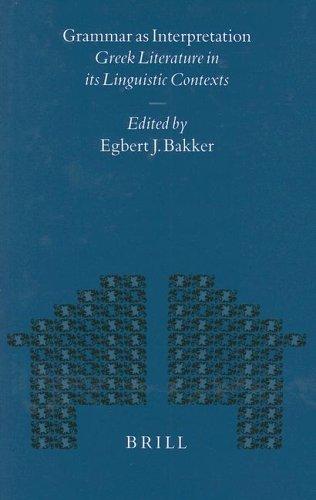
Grammar as Interpretation
0
0
As an Amazon Associate and affiliate partner, Menrva Books earns from qualifying purchases. Learn more
Author Description
Looking at its subject from the standpoint of modern discourse analysis, this study deals with problems of style and grammar in Greek and Latin texts. Its aim is to shed light on the interaction between the mechanism of the Greek and Latin languages as interactive tools and the structure of the texts that have come down to us. The interpretive orientation offered differs from most literary studies in its taking linguistic observations as point of departure, and its considering grammar as a positive factor in the interpretive process. It differs from most linguistic studies in the field in demonstrating the importance of linguistic methodology for classical philology in general. The book contains explorations of various authors, genres, and text types, preceded by an introductory essay on the role of grammar in philology.
Menrva's Summary
THE THESIS
This study investigates the role of grammar and linguistic interpretation in understanding ancient Greek and Latin texts. Egbert J. Bakker, drawing on modern discourse analysis, explores the intricate relationship between the grammatical structures of these languages and the resulting textual forms. The book posits that grammar is not merely a descriptive tool but an active component in the interpretive process, offering a unique perspective that bridges linguistic methodology and classical philology.
THE SCOPE MAP
- Explorations of various authors, genres, and text types in Greek and Latin.
- An introductory essay on the fundamental role of grammar in philology.
- Analysis of the interaction between language mechanisms and textual structures.
- Application of modern discourse analysis to classical texts.
- Consideration of grammar as a positive factor in textual interpretation.
THE AUTHORITY PERSPECTIVE
The book is recognized for its innovative approach, taking linguistic observations as its primary departure point for literary studies. It aims to demonstrate the significance of linguistic methodology for classical philology, distinguishing itself from both traditional literary analyses and purely linguistic studies. The work is structured to provide a comprehensive exploration of grammar's interpretive power within the classical context.
Page Count:
262
Publication Date:
1997-01-01
ISBN-10:
9004107304
Non-Fiction
History
Literary Fiction
Grammar
Philology
Linguistics
Literary Analysis
Community Tags
Similar Books