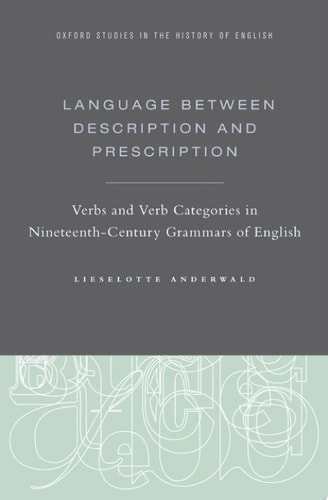
Language Between Description and Prescription: Verbs and Verb Categories in Nineteenth-Century Grammars of English
0
0
As an Amazon Associate and affiliate partner, Menrva Books earns from qualifying purchases. Learn more
Author Description
Language Between Description and Prescription is an empirical, quantitative and qualitative study of nineteenth-century English grammar writing, and of nineteenth-century language change. Based on 258 grammar books from Britain and North America, the book investigates whether grammar writers of the time noticed the language changing around them, and how they reacted. In particular, Lieselotte Anderwald demonstrates that not all features undergoing change were noticed in the first place, those that were noticed were not necessarily criticized, and some recessive features were not upheld as correct. The features investigated come from the verb phrase and include in particular variable past tense forms, which -although noticed-often went uncommented, and where variation was acknowledged; the decline of the be-perfect, where the older form (the be-perfect) was criticized emphatically, and corrected; the rise of the progressive, which was embraced enthusiastically, and which was even upheld as a symbol of national superiority, at least in Britain; the rise of the progressive passive, which was one of the most violently hated constructions of the time, and the rise of the get-passive, which was only rarely commented on, and even more rarely in negative terms. Throughout the book, nineteenth-century grammarians are given a voice, and the discussions in grammar books of the time are portrayed. The book's quantitative approach makes it possible to examine majority and minority positions in the discourse community of nineteenth-century grammar writers, and the changes in accepted opinion over time. The terms of the debate are also investigated, and linked to the wider cultural climate of the time. Although grammar writing in the nineteenth century was very openly prescriptivist, the studies in this book show that many prescriptive dicta contained interesting grains of descriptive detail, and that eventually prescriptivism had only a small-scale, short-term effect on the actual language.
Menrva's Summary
THE THESIS
This study investigates the tension between descriptive observation and prescriptive intervention in nineteenth-century English grammar books to determine how contemporary writers perceived and reacted to ongoing language change. Lieselotte Anderwald, a scholar specializing in the history of English, utilizes a corpus of 258 grammar texts from Britain and North America to analyze the discourse of the era. By applying both quantitative and qualitative methods, the author evaluates whether grammarians identified specific linguistic shifts and how their reactions influenced the codification of English during this period.
THE SCOPE MAP
What You Will Find
- A corpus-based analysis of 258 nineteenth-century English grammar books.
- Examination of specific verb phrase developments, including past tense variation, the be-perfect, the progressive, the progressive passive, and the get-passive.
- A comparative study of British and North American prescriptive attitudes.
- Analysis of the correlation between linguistic commentary and the broader cultural climate of the nineteenth century.
Scope Limits
- The study focuses primarily on verb phrase features and does not provide an exhaustive account of all grammatical categories.
- The research is limited to the specific discourse community of nineteenth-century grammar writers and does not track actual spoken usage patterns outside of these texts.
THE AUTHORITY PERSPECTIVE
Experts recognize this work as a significant contribution to the history of English linguistics, particularly for its rigorous quantitative methodology in analyzing prescriptive texts. Readers frequently note the academic density of the prose, which serves as a foundational resource for scholars interested in the evolution of grammatical norms and the history of language attitudes.
Page Count:
352
Publication Date:
2016-01-01
Publisher:
Oxford University Press
ISBN-10:
0190624663
ISBN-13:
9780190624668
History
English History
Nineteenth century
English
Academic
Linguistics
English & College Success
European History
Grammar
English language standardization
Community Tags
Similar Books
Reader Comments
Share Your Thoughts
No comments yet. Be the first to share your thoughts!