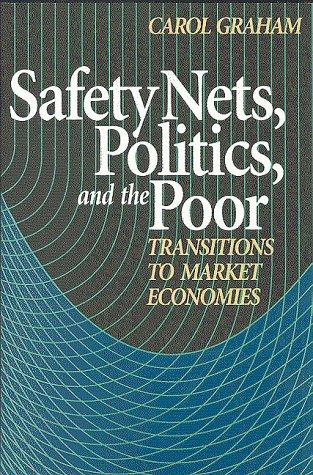
Safety Nets, Politics and the Poor
0
0
As an Amazon Associate and affiliate partner, Menrva Books earns from qualifying purchases. Learn more
Author Description
In this book, Carol Graham argues that safety nets can provide an environment in which economic reform is more politically sustainable and poverty can be permanently reduced. However, these two objectives frequently involve trade-offs, as vocal and organized opponents to reform often concern governments far more than the poor do. These organized and less vulnerable groups tend to place heavy demands on the scarce resources available to governments at times of economic crisis. Governments that fail to address the social costs of reform, meanwhile, often face popular opposition that jeopardizes or even derails the entire market transition. The author examines these trade-offs in detail, with a particular focus on how political and institutional contexts affect the kinds of safety nets that are implemented. For example, reaching the poor and vulnerable with safety nets tends to be more difficult in closed-party systems where entrenched interest groups have a monopoly on state benefits. In contrast, dramatic political change or rapid implementation of economic reform undermines the influence of such groups and therefore can provide unique political opportunities to redirect resources to the poor. Rather than focus their efforts on organized interest groups - such as public sector unions - which have a great deal to lose in the process of reform, governments might better concentrate their efforts on poor groups that have rarely, if ever, received benefits from the state. The poor, meanwhile, may gain a new stake in the ongoing process of economic and public sector reform through organizing to solicit the state for safety net benefits. This is the first book to provide a detailed and comparative analysis of compensation during economic reform. Graham offers specific examples of resource allocation in three regions: Latin America, eastern Europe, and Africa. She features case studies from Bolivia, Chile, Peru, Poland, Senegal, and Zambia. The case studies yield valuab
Menrva's Summary
THE THESIS
This book investigates how social safety nets influence the political sustainability of economic reforms and the reduction of poverty. Carol Graham argues that while safety nets can facilitate these objectives, governments often face a trade-off due to the greater political influence of vocal, organized opponents of reform compared to the poor. These less vulnerable groups can place significant demands on scarce government resources during economic crises, potentially jeopardizing reform efforts. The book examines how political and institutional contexts shape the implementation of safety nets, noting that reaching the poor is more challenging in closed-party systems dominated by entrenched interests.
THE SCOPE MAP
- Analysis of the trade-offs between economic reform and poverty reduction through safety nets.
- Examination of how political and institutional contexts affect safety net implementation.
- Case studies from Latin America, Eastern Europe, and Africa.
- Specific examples from Bolivia, Chile, Peru, Poland, Senegal, and Zambia.
- Discussion on how governments can better direct resources to poor groups.
- Exploration of how the poor can gain a stake in reform by organizing for benefits.
- Comparative analysis of compensation during economic reform.
THE AUTHORITY PERSPECTIVE
This book is recognized as a significant contribution to the literature on economic reform and social policy, offering a detailed comparative analysis of compensation mechanisms during transitions. The author's examination of trade-offs between political sustainability and poverty reduction, particularly concerning the influence of organized interest groups versus the needs of the poor, provides a nuanced perspective. The inclusion of case studies from diverse regions like Latin America, Eastern Europe, and Africa allows for a broad understanding of these complex dynamics. The work is noted for its detailed examination of how political and institutional contexts critically shape the effectiveness and reach of safety nets.
Page Count:
378
Publication Date:
1997-01-01
ISBN-10:
0815732287
ISBN-13:
9780815732280
Non-Fiction
Politics
Economics
Social Science
Community Tags
Similar Books