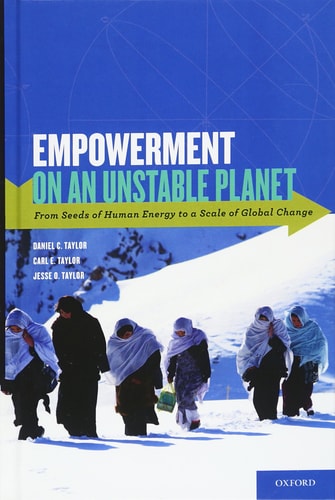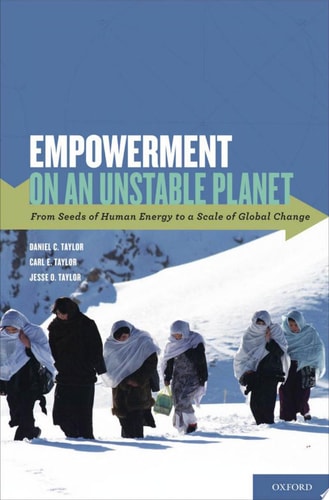
Empowerment on an Unstable Planet
0
0
As an Amazon Associate and affiliate partner, Menrva Books earns from qualifying purchases. Learn more
Author Description
Since World War II, development projects have invested more than two trillion dollars towards health services, poverty alleviation, education, food security, and environmental initiatives around the world. Despite these efforts, 20% of the world still lives on less than $1.50 a day and the environment within which all live declines dramatically. There are clear limits to what further investments at this rate can achieve. This book advances the thesis that a more effective and universal foundation for social change and environmental restoration is not money, but human energy. Using this approach Tibet recovered from being nearly deforested to having over 40% of its land area protected under conservation management. Using principles outlined in this book mothers in Northeast India implemented a package of life-changing actions that halved child mortality. They parallel the way New York City has created a citywide conservation program over three-and-a-half centuries. Each of these examples is particular to its time and place, yet a shared set of principles is at work in all of them. Improving the quality of life for a community starts by strengthening successes already operating. It involves local knowledge and a relatively simple set of principles, tasks, and criteria designed to empower communities. This highly readable account demonstrates how a comprehensive process for social change harnesses the energy of a community and scales it up with a rising number of participants becoming invested in increasingly high-quality work. Richly illustrated with photographs and stories of innovative people and programs in communities ranging from Nepal to Afghanistan to the South Bronx, it provides practical, proven guidelines for creating profound and sustained social change that begins in individual communities and grows to scale.
Menrva's Summary
THE THESIS
This book investigates whether human energy, rather than financial investment, serves as a more effective and sustainable foundation for achieving global social change and environmental restoration. Author Daniel C. Taylor, drawing on his extensive background in international development and conservation, argues that traditional funding models have failed to address systemic poverty and ecological decline. By analyzing diverse case studies from Tibet to the South Bronx, he presents a framework that prioritizes local knowledge and the scaling of existing community successes to create lasting impact.
THE SCOPE MAP
What You Will Find
- A comparative analysis of development initiatives across Nepal, India, Afghanistan, and the United States.
- A structured methodology for identifying and strengthening existing community successes to drive social progress.
- Case studies demonstrating the practical application of community-led conservation and health programs.
- A set of core principles and criteria designed to empower local populations and scale grassroots efforts.
THE AUTHORITY PERSPECTIVE
Experts and practitioners in the field of international development frequently cite this work for its pragmatic approach to community-based change. Readers often note that the prose is accessible and effectively bridges the gap between high-level theory and on-the-ground implementation.
Page Count:
296
Publication Date:
2011-01-01
Publisher:
Oxford University Press, Incorporated
ISBN-10:
0199842973
ISBN-13:
9780199842971
Social Science
Community Development
Social change
Social Action
Sustainability
Community action
Sociology
Community Tags
Similar Books