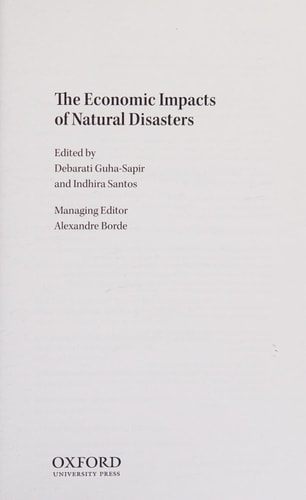
The Economic Impacts of Natural Disasters
0
0
As an Amazon Associate and affiliate partner, Menrva Books earns from qualifying purchases. Learn more
Author Description
Since the turn of the millennium, more than one million people have been killed and 2.3 billion others have been directly affected by natural disasters around the world. In cases like the 2010 Haiti earthquake or the 2004 Indian Ocean tsunami, these disasters have time and time again wrecked large populations and national infrastructures. While recognizing that improved rescue, evacuation, and disease control are crucial to reducing the effects of natural disasters, in the final analysis, poverty remains the main risk factor determining the long-term impact of natural hazards. Furthermore, natural disasters have themselves a tremendous impact on the poorest of the poor, who are often ill-prepared to deal with natural hazards and for whom a hurricane, an earthquake, or a drought can mean a permanent submersion in poverty.The Economic Impacts of Natural Disasters focuses on these concerns for poverty and vulnerability. Written by a collection of esteemed scholars in disaster management and sustainable development, the report provides an overview of the general trends in natural disasters and their effects by focusing on a critical analysis of different methodologies used to assess the economic impact of natural disasters. Economic Impacts presents six national case studies (Bangladesh, Vietnam, India, Nicaragua, Japan and the Netherlands) and shows how household surveys and country-level macroeconomic data can analyze and quantify the economic impact of disasters. The researchers within Economic Impacts have created path-breaking work and have opened new avenues for thinking and debate to push forward the frontiers of knowledge on economics of natural disasters.
Menrva's Summary
THE THESIS
This work investigates the causal relationship between natural disasters and long-term economic instability, specifically focusing on how poverty serves as the primary determinant for vulnerability. Alexandre Borde and a team of scholars in disaster management utilize a combination of macroeconomic data and household-level surveys to evaluate the financial consequences of large-scale hazards. The text argues that while emergency response is vital, the systemic economic impact on impoverished populations requires a more rigorous analytical framework to mitigate permanent developmental setbacks.
THE SCOPE MAP
What You Will Find
- Comparative analysis of six national case studies including Bangladesh, Vietnam, India, Nicaragua, Japan, and the Netherlands.
- Methodological frameworks for quantifying the economic impact of natural disasters on national infrastructure.
- Integration of household survey data with country-level macroeconomic indicators.
- Examination of the correlation between poverty levels and the duration of post-disaster economic recovery.
THE AUTHORITY PERSPECTIVE
Experts recognize this volume as a significant contribution to the field of disaster economics, particularly for its focus on the intersection of poverty and hazard vulnerability. Readers frequently note the technical density of the case studies, which provide a structured approach for researchers and policy makers to assess long-term economic damage.
Page Count:
326
Publication Date:
2013-05-02
Publisher:
Oxford University Press
ISBN-10:
0199841934
ISBN-13:
9780199841936
Economics
Public Policy
Community Tags
Similar Books