
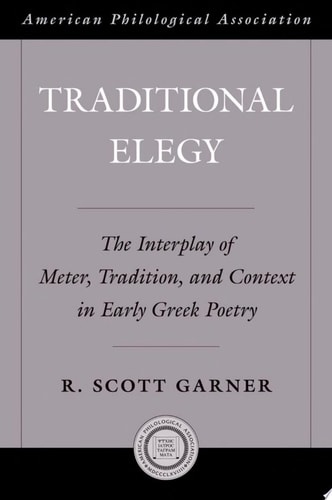
Traditional Elegy: The Interplay of Meter, Tradition, and Context in Early Greek Poetry
0
0
As an Amazon Associate and affiliate partner, Menrva Books earns from qualifying purchases. Learn more
Author Description
Though often assumed by scholars to be a product of traditional, and perhaps oral, compositional practices comparable to those found in early Greek epic, archaic elegy has not until this point been analyzed in similar detail with respect to such verse-making techniques. This volume is intended to redress some of this imbalance by exploring several issues related to the production of Greek elegiac poetry. By investigating elegy's metrical partitioning and its localizing patterns of repeated phraseology, Traditional Elegy makes clear that the oral-formulaic processes lying at the heart of Homeric epic bear close resemblance to those that also originally made archaic elegy possible. However, the volume's argument is then able to be pressed even further by looking at the most common metrical "anomaly" in early elegy-epic correption-in order to demonstrate that elegiac poets in the Archaic Period were not simply mimicking an earlier productive style but were actively engaging with such traditional techniques in order to produce and reproduce their own poems. Because correption exhibits several patterns of employment that depend upon the meshing and adapting of traditional phraseological units, it becomes clear that in elegy--just as it is in epic--this metrical phenomenon is inextricably entwined with traditional techniques of verse-composition, and we therefore have strong evidence that elegiac poets of the Archaic Period were still making active use of these oral-formulaic techniques, even if actual oral composition itself cannot be proven for any individual author or poetic fragment. The implications of such findings are quite large, as they require a wholesale shift in our modern methods of inquiry into elegy for a wide range of concerns of meter, phraseology, and even the much broader issues of intended meaning and overall aesthetics.
Menrva's Summary
THE THESIS
This volume investigates whether the compositional techniques of early Greek elegy mirror the oral-formulaic processes identified in Homeric epic poetry. R. Scott Garner, a scholar of classical literature, utilizes a rigorous analysis of metrical partitioning and phraseological patterns to challenge the assumption that archaic elegy functioned independently of traditional epic verse-making. By examining specific metrical anomalies, the author argues that archaic poets actively adapted traditional techniques rather than merely imitating them, suggesting a deeper continuity in Greek poetic production.
THE SCOPE MAP
What You Will Find
- A detailed examination of metrical partitioning and repeated phraseology in archaic Greek elegy.
- An analysis of epic correption as a functional tool for verse composition.
- Comparative study between Homeric epic structures and elegiac poetic forms.
- A proposed framework for reevaluating the aesthetics and intended meaning of early Greek poetry.
THE AUTHORITY PERSPECTIVE
Experts in classical philology recognize this work as a significant contribution to the study of oral-formulaic theory within the context of archaic elegy. Scholars frequently note the technical density of the prose, which serves as a specialized resource for those researching the intersection of meter and poetic tradition.
Page Count:
176
Publication Date:
2011-01-01
Publisher:
Oxford University Press
ISBN-10:
0199842418
ISBN-13:
9780199842414
History
Poetry
English & College Success
English
Academic
Ancient History
Literary Criticism
Community Tags
Other Editions(2)
Similar Books

Reader Comments
Share Your Thoughts
No comments yet. Be the first to share your thoughts!