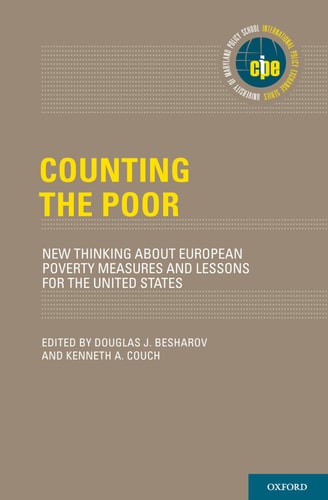
Counting the Poor: New Thinking About European Poverty Measures and Lessons for the United States
0
0
As an Amazon Associate and affiliate partner, Menrva Books earns from qualifying purchases. Learn more
Author Description
The poverty rate is one of the most visible ways in which nations measure the economic well-being of their low-income citizens. To gauge whether a person is poor, European states often focus on a person's relative position in the income distribution to measure poverty while the United States looks at a fixed-income threshold that represents a lower relative standing in the overall distribution to gauge. In Europe, low income is perceived as only one aspect of being socially excluded, so that examining other relative dimensions of family and individual welfare is important. This broad emphasis on relative measures of well-being that extend into non-pecuniary aspects of people's lives does not always imply that more people would ultimately be counted as poor. This is particularly true if one must be considered poor in multiple dimensions to be considered poor, in sharp contrast to the American emphasis on income as the sole dimension.With contributions from the world's foremost authorities on income and social measurement, the book provides detailed discussions of specific issues from a European perspective followed by commentary from American observers. The volume considers (1) current standards of poverty measurement in the European Union and the Organization for Economic Co-operation and Development, (2) challenges in extending those measures to account for the value of the provision of in-kind and cash benefits from the government, (3) the interaction of poverty measures with social assistance, (4) non-income but monetary measures of poverty, and (5) multi-dimensional measures of poverty. The result is a definitive reference for poverty researchers and policymakers seeking to disengage politics from measurement.
Menrva's Summary
THE THESIS
This volume investigates the methodological discrepancies between European and American approaches to measuring poverty and the implications of these differences for social policy. Douglas J. Besharov and Kenneth A. Couch assemble a collection of essays from international experts to evaluate how relative income distributions, social exclusion, and multi-dimensional welfare indicators compare to the traditional American fixed-income threshold. The text argues for a more nuanced framework that accounts for in-kind benefits and non-pecuniary factors to improve the accuracy of poverty assessment across developed nations.
THE SCOPE MAP
What You Will Find
- Comparative analysis of poverty measurement standards within the European Union and the OECD.
- Methodologies for incorporating government-provided cash and in-kind benefits into poverty calculations.
- Examination of non-income monetary indicators and multi-dimensional welfare metrics.
- Critical commentary from American observers on the applicability of European social assistance models.
THE AUTHORITY PERSPECTIVE
Experts identify this work as a foundational text for policymakers and researchers interested in the technical nuances of social welfare metrics. Readers frequently note the academic density of the prose, which serves as a rigorous reference for those seeking to separate political rhetoric from empirical measurement.
Page Count:
448
Publication Date:
2012-06-15
Publisher:
Oxford University Press
ISBN-10:
0199860580
ISBN-13:
9780199860586
Economics
Poverty
Sociology
United States
European Union
Public Policy
Community Tags
Similar Books