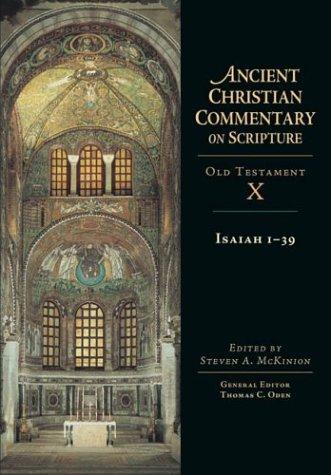
Isaiah 1-39
0
0
As an Amazon Associate and affiliate partner, Menrva Books earns from qualifying purchases. Learn more
Author Description
For the early church fathers the prophecy of Isaiah was not a compendium of Jewish history or theology but an announcement of the coming Messiah fulfilled in the life and ministry of Jesus of Nazareth. As such, the prophet's words were a rich source of theological reflection concerning their Lord and a vital aid in their defense against the objections of the Jews that Jesus was the promised Messiah. The interpretation of Jesus' ministry in light of Isaiah's prophecy was not a theological innovation on their part but rather a following of the path blazed by the New Testament writers and Jesus himself. Among passage-by-passage commentaries cited here are those by Eusebius of Caesarea, Jerome, Cyril of Alexandria and Theodoret of Cyr, as well as one attributed to Basil of Caesarea. John Chrysostom preached a series of homilies on Isaiah of which most of those extant concern the first eight chapters, though Chrysostom frequently cites Isaiah in numerous homilies on other books. Augustine of Hippo, Gregory the Great and Bede the Venerable frequently cite passages from Isaiah 1-39, as did many other fathers in defending the Christian faith from Jewish critics.
Menrva's Summary
THE THESIS
This book investigates how early church fathers interpreted the prophecies of Isaiah, particularly Isaiah 1-39, as a testament to Jesus Christ. The author, Steven A. McKinion, examines the theological reflections and apologetic uses of Isaiah's words by prominent figures such as Eusebius of Caesarea, Jerome, Cyril of Alexandria, Augustine of Hippo, and Gregory the Great. The work focuses on how these early Christian thinkers utilized Isaiah's prophecies to defend their faith against Jewish critics and to articulate their understanding of Jesus' messianic identity. The analysis is grounded in passage-by-passage commentaries and homilies from these influential church fathers.
THE SCOPE MAP
- Analysis of Isaiah 1-39 through the lens of early church fathers.
- Examination of theological reflection on the coming Messiah.
- Exploration of apologetic use of Isaiah in defense against Jewish objections.
- Detailed study of commentaries and homilies from key figures like Eusebius, Jerome, Cyril of Alexandria, Augustine, and Gregory the Great.
- Discussion of the New Testament and Jesus' own use of Isaiah's prophecies.
- Focus on the interpretation of Jesus' ministry in light of Isaiah's predictions.
THE AUTHORITY PERSPECTIVE
This scholarly work is likely to be regarded as a significant contribution to the study of patristic exegesis and early Christian apologetics. Its focus on a specific section of Isaiah and its detailed engagement with primary sources suggest a text valuable for scholars and students of biblical interpretation and church history. The book's approach highlights the continuity between New Testament usage and later patristic interpretation of Isaiah.
Page Count:
300
Publication Date:
2004-01-01
ISBN-10:
0830814809
ISBN-13:
9780830814800
Religion
History
Non-Fiction
Church History
Commentary
Christian Theology
Community Tags
Similar Books