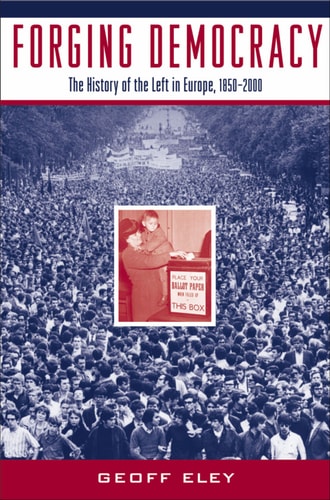
Forging Democracy: The History of the Left in Europe, 1850-2000
0
0
As an Amazon Associate and affiliate partner, Menrva Books earns from qualifying purchases. Learn more
Author Description
Neither given nor granted, democracy requires conflict, often violent confrontations, and challenges to the established political order. In Europe, Geoff Eley convincingly shows, democracy did not evolve orgainically out of a natural consensus, the achievement of prosperity, or the negative cement of the Cold War. Rather, it was painstakingly crafted, continually expanded, and doggedly defended by varying constellations of socialist, feminist, Communist, and other radical movements that originally blossomed in the later nineteenth century. Parties of the Left championed democracy in the revolutionary crisis after World War I, salvaged it against the threat of fascism, and renewed its growth after 1945. They organized civil societies rooted in egalitarian ideals which came from the very fiber of Europe's current democratic traditions. The trajectories of European democracy and the history of the European Left are thus inextricably bound together.
Menrva's Summary
THE THESIS
This book investigates the historical assertion that European democracy was not an organic evolution, but rather a product of intense conflict and the persistent efforts of radical political movements. Geoff Eley, a distinguished historian of modern Europe, utilizes a vast array of political and social history to argue that the democratic structures of the continent were forged through the struggles of socialist, communist, and feminist organizations. By examining the period from 1850 to 2000, Eley demonstrates how these groups defended and expanded democratic rights against authoritarian threats and institutional resistance. The work provides a comprehensive framework for understanding how egalitarian ideals were integrated into the foundational fabric of modern European governance.
THE SCOPE MAP
What You Will Find
- A detailed historical analysis of European political movements from 1850 to 2000.
- Examination of the role of socialist and communist parties in the post-World War I revolutionary crises.
- Analysis of how radical movements countered the rise of fascism and shaped post-1945 political landscapes.
- Exploration of the development of civil societies rooted in egalitarian principles.
THE AUTHORITY PERSPECTIVE
Historians and political scientists frequently cite this work as a definitive account of the symbiotic relationship between the European Left and the development of democratic institutions. Readers often note the academic density of the prose, which provides a rigorous and thorough examination of complex political trajectories.
Page Count:
719
Publication Date:
2002-01-01
Publisher:
Oxford University Press
ISBN-10:
0199878773
ISBN-13:
9780199878772
History
Sex Role
Socialism
Political Movements
European History
Community Tags
Similar Books