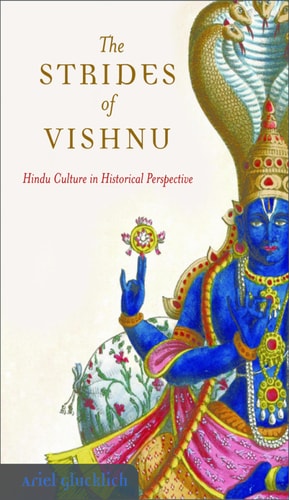
The Strides of Vishnu: Hindu Culture in Historical Perspective
0
0
As an Amazon Associate and affiliate partner, Menrva Books earns from qualifying purchases. Learn more
Author Description
Books about Hinduism often begin by noting the immense size and complexity of the subject. Hinduism is vast and diverse, they say. Or it doesn't exist at all - Hinduism is merely a convenient (and foreign) term that masks a plurality of traditions. In either case, readers are discouraged by the sense that they are getting only a tiny sample or a shallow overview of something huge and impossible to understand. This book is designed to be accessible and comprehensive in a way that other introductions are not, maintaining an appealing narrative and holding the reader's interest in the unfolding sequence of ideas through time and place. Each of the 13 chapters combines historical material with key religious and philosophical ideas, supported by substantial quotations from scriptures and other texts. The overarching organizational principle is a historical narrative largely grounded in archaeological information. Historic places and persons are fleshed out as actors in a narrative about the relation of the sacred to ordinary existence as it is mediated through arts, sciences, rituals, and philosophical ideas. Although many books purport to introduce the Hindu tradition, this is the only one with a broad historical focus that emphasizes archaeological as well as textual evidence. It will nicely complement Vasuda Narayanan's forthcoming introduction, which takes the opposite approach of focusing on the lived experience of Hindu believers.
Menrva's Summary
THE THESIS
This book investigates the historical development and cultural complexity of Hinduism by synthesizing archaeological data with textual analysis to provide a comprehensive overview. Ariel Glucklich, a scholar of religious studies, utilizes a chronological framework to move beyond the common perception of Hinduism as an amorphous or impossible-to-define subject. By grounding the narrative in historical sites and figures, the author argues that the tradition is best understood through the interplay of sacred concepts and ordinary human existence across time.
THE SCOPE MAP
What You Will Find
- A thirteen-chapter historical narrative spanning the development of Hindu traditions.
- Integration of archaeological evidence alongside traditional scriptural analysis.
- Examination of how arts, sciences, and rituals mediate the relationship between the sacred and the mundane.
- Substantial primary source quotations from foundational Hindu texts.
THE AUTHORITY PERSPECTIVE
Experts highlight this work as a distinct contribution to the field due to its specific emphasis on archaeological evidence as a primary lens for understanding religious history. Readers frequently note that the text successfully balances academic rigor with an accessible narrative structure suitable for those seeking a comprehensive introduction to the subject.
Page Count:
244
Publication Date:
2008-01-01
Publisher:
Oxford University Press
ISBN-10:
0199886148
ISBN-13:
9780199886142
Religion
History
Philosophy
Non-Fiction
India
Archaeology
Hinduism
Community Tags
Similar Books