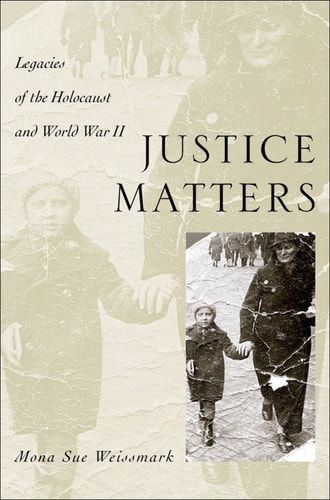
Justice Matters: Legacies of the Holocaust and World War II
0
0
As an Amazon Associate and affiliate partner, Menrva Books earns from qualifying purchases. Learn more
Author Description
In the fall of 1992, in a small room in Boston, MA, an extraordinary meeting took place. For the first time, the sons and daughters of Holocaust victims met face-to-face with the children of Nazis for a fascinating research project to discuss the intersections of their pasts and the painful legacies that history has imposed on them. Taking that remarkable gathering as its starting point, Justice Matters illustrates how the psychology of hatred and ethnic resentments is passed from generation to generation. Psychologist Mona Weissmark, herself the child of Holocaust survivors, argues that justice is profoundly shaped by emotional responses. In her in-depth study of the legacy encountered by these children, Weissmark found, not surprisingly, that in the face of unjust treatment, the natural response is resentment and deep anger-and, in most cases, an overwhelming need for revenge. Weissmark argues that, while legal systems offer a structured means for redressing injustice, they have rarely addressed the emotional pain, which, left unresolved, is then passed along to the next generation-leading to entrenched ethnic tension and group conflict. In the grim litany of twentieth-century genocides, few events cut a broader and more lasting swath through humanity than the Holocaust. How then would the offspring of Nazis and survivors react to the idea of reestablishing a relationship? Could they talk to each other without open hostility? Could they even attempt to imagine the experiences and outlook of the other? Would they be willing to abandon their self-definition as aggrieved victims as a means of moving forward? Central to the perspectives of each group, Weissmark found, were stories, searing anecdotes passed from parent to grandchild, from aunt to nephew, which personalized with singular intensity the experience. She describes how these stories or "legacies" transmit moral values, beliefs and emotions and thus freeze the past into place.
Menrva's Summary
THE THESIS
How do the intergenerational legacies of trauma and hatred influence the perception of justice among the descendants of Holocaust survivors and Nazi perpetrators? Psychologist Mona Sue Weissmark, herself a child of Holocaust survivors, utilizes a unique longitudinal study involving face-to-face meetings between these two groups to examine the transmission of ethnic resentment. She argues that formal legal systems often fail to address the deep-seated emotional pain that fuels cycles of conflict, suggesting that justice requires a psychological component to break the transmission of inherited grievances.
THE SCOPE MAP
What You Will Find
- Analysis of the 1992 Boston meeting between children of survivors and children of Nazis
- Examination of how personal narratives and family stories transmit moral values and trauma
- Application of psychological frameworks to understand the cycle of resentment and revenge
- Evaluation of the limitations of legal systems in resolving historical group conflict
THE AUTHORITY PERSPECTIVE
Experts and readers recognize this work as a significant contribution to the study of intergenerational trauma and the psychology of conflict. The text is noted for its accessible yet rigorous approach to sensitive historical subject matter, making it a valuable resource for those interested in the intersection of history and human behavior.
Page Count:
210
Publication Date:
2003-01-01
Publisher:
Oxford University Press
ISBN-10:
0199882711
ISBN-13:
9780199882717
Psychology
History
Holocaust
Counseling Psychology
Ethics
Kindle Store
Categories
Social Science
Conflict Resolution
Kindle eBooks
Community Tags
Similar Books