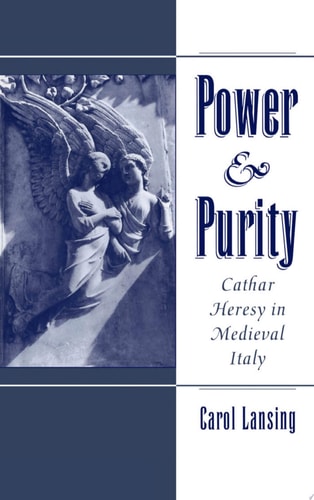
Power & Purity: Cathar Heresy in Medieval Italy
0
0
As an Amazon Associate and affiliate partner, Menrva Books earns from qualifying purchases. Learn more
Author Description
Catharism was a popular medieval heresy based on the belief that the creation of humankind was a disaster in which angelic spirits were trapped in matter by the devil. Their only goal was to escape the body through purification. Cathars denied any value to material life, including the human body, baptism, and the Eucharist, even marriage and childbirth. What could explain the long popularity of such a bleak faith in the towns of southern France and Italy?Power and Purity explores the place of cathar heresy in the life of the medieval Italian town of Orvieto. Based on extensive archival research, it details the social makeup of the Cathar community and argues that the heresy was central to the social and political changes of the 13th century. The late 13th-century repression of Catharism by a local inquisition was part of a larger redefinition of civic and ecclesiastical authority. Author Carol Lansing shows that the faith attracted not an alienated older nobility but artisans, merchants, popular political leaders, and indeed circles of women in Orvieto as well as Florence and Bologna. Cathar beliefs were not so much a pessimistic anomaly as a part of a larger climate of religious doubt. The teachings on the body and the practice of Cathar holy persons addressed questions of sexual difference and the structure of authority that were key elements of medieval Italian life. The pure lives of the Cathar holy people, both male and female, demonstrated a human capacity for self-restraint that served as a powerful social model in towns torn by violent conflict. This study addresses current debates about the rise of persecution, and argues for a climate of popular toleration. Power and Purity will appeal to historians of society and politics as well as religion and gender studies.
Menrva's Summary
THE THESIS
This work investigates the social and political integration of Cathar heresy within the 13th-century Italian town of Orvieto to understand why such a restrictive faith maintained long-term popularity. Carol Lansing, a historian specializing in medieval Italy, utilizes extensive archival records to challenge the notion that Catharism was merely an alienated fringe movement. She argues that the faith was deeply embedded in the civic life of the era, serving as a response to broader questions regarding authority, gender, and social structure during a period of intense political transition.
THE SCOPE MAP
What You Will Find
- Analysis of the social demographics of Cathar communities in Orvieto, Florence, and Bologna.
- Examination of the intersection between religious practice and 13th-century civic authority.
- Investigation into the role of Cathar holy persons as models of self-restraint in conflict-ridden urban centers.
- Discussion of the late 13th-century inquisitorial repression as a tool for political redefinition.
Scope Limits
- The study focuses primarily on the urban environments of central and northern Italy rather than the broader European Cathar movement.
- The research does not provide a comprehensive theological treatise on Cathar doctrine, focusing instead on the social and political implications of the faith.
THE AUTHORITY PERSPECTIVE
Historians and scholars of medieval studies frequently cite this text for its rigorous archival methodology and its nuanced approach to the relationship between heresy and civic identity. The prose is noted for its academic density and its ability to synthesize complex social history for researchers in the fields of religion and gender studies.
Page Count:
278
Publication Date:
1998-01-01
Publisher:
Oxford University Press
ISBN-10:
0190281693
ISBN-13:
9780190281694
History
Europe
Religious History
Church Leadership
Categories
Sociology
Italy history
Albigenses
Kindle eBooks
Heresy
Italy
Gender Studies
Kindle Store
Church History
European History
Community Tags
Similar Books