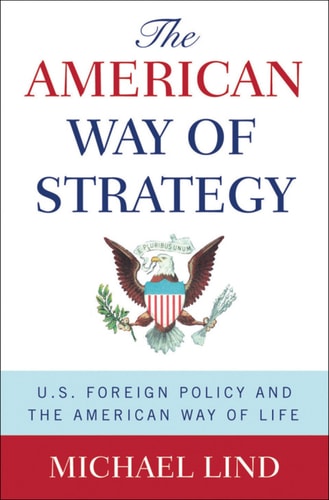
The American Way of Strategy: U.S. Foreign Policy and the American Way of Life
0
0
As an Amazon Associate and affiliate partner, Menrva Books earns from qualifying purchases. Learn more
Author Description
Americans are unlikely to lose their cherished rights because of a military coup or a foreign conquest, writes Michael Lind. The more plausible and frightening scenario is one in which foreign danger forces Americans themselves to jettison their way of life, sacrificing liberty to ensure security. To prevent this scenario from happening is the real purpose of American strategy. In The American Way of Strategy, Lind argues that the goal of U.S. foreign policy has always been the preservation of the American way of life--embodied in civilian government, checks and balances, a commercial economy, and individual freedom. Lind describes how successive American statesmen--from George Washington, Thomas Jefferson, and Alexander Hamilton to Franklin Roosevelt, Dwight Eisenhower, and Ronald Reagan--have pursued an American way of strategy that minimizes the dangers of empire and anarchy by two means: liberal internationalism and realism. At its best, the American way of strategy is a well-thought-out and practical guide designed to preserve a peaceful and demilitarized world by preventing an international system dominated by imperial and militarist states and its disruption by anarchy. When American leaders have followed this path, they have lead our nation from success to success, and when they have deviated from it, the results have been disastrous. Framed in an engaging historical narrative, the book makes an important contribution to contemporary debates. The American Way of Strategy is certain to change the way that Americans understand U.S. foreign policy.
Menrva's Summary
THE THESIS
The central question of this work is how the United States can maintain its domestic democratic institutions and individual liberties while navigating the pressures of global security and international power dynamics. Michael Lind, a noted political analyst and historian, examines the historical evolution of U.S. foreign policy through the lens of preserving the American way of life. He argues that the primary objective of national strategy should be the protection of civilian governance and a commercial economy, rather than the pursuit of empire or ideological crusades. By analyzing the successes and failures of past administrations, Lind posits that a synthesis of liberal internationalism and realism provides the most effective framework for long-term national stability.
THE SCOPE MAP
What You Will Find
- A historical analysis of U.S. foreign policy from the Founding Fathers to the late 20th century.
- An examination of the tension between domestic liberty and the requirements of national security.
- A comparative study of liberal internationalism and realism as strategic doctrines.
- Case studies of presidential administrations, including those of Washington, Jefferson, Hamilton, Roosevelt, Eisenhower, and Reagan.
THE AUTHORITY PERSPECTIVE
Experts and political commentators frequently cite this work as a significant contribution to the discourse on American grand strategy. Readers often note the clarity of the historical narrative and the author's ability to synthesize complex geopolitical theories into a coherent argument for modern policy makers.
Page Count:
304
Publication Date:
2006-01-01
Publisher:
Oxford University Press
ISBN-10:
0199885796
ISBN-13:
9780199885794
History
International relations
American History
United States
Foreign Policy
National characteristics American
International Security
Community Tags
Similar Books