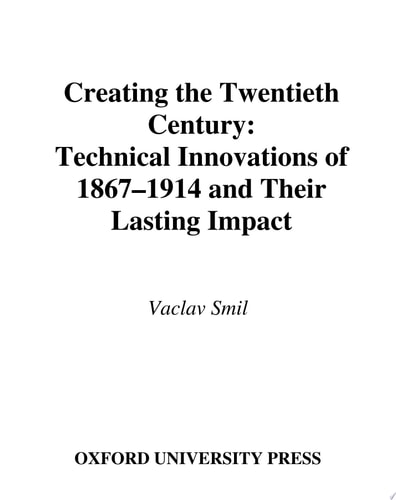
Creating the Twentieth Century: Technical Innovations of 1867-1914 and Their Lasting Impact
0
0
As an Amazon Associate and affiliate partner, Menrva Books earns from qualifying purchases. Learn more
Author Description
The period between 1867 and 1914 remains the greatest watershed in human history since the emergence of settled agricultural societies: the time when an expansive civilization based on synergy of fuels, science, and technical innovation was born. At its beginnings in the 1870s were dynamite, the telephone, photographic film, and the first light bulbs. Its peak decade - the astonishing 1880s - brought electricity - generating plants, electric motors, steam turbines, the gramophone, cars, aluminum production, air-filled rubber tires, and prestressed concrete. And its post-1900 period saw the first airplanes, tractors, radio signals and plastics, neon lights and assembly line production. This book is a systematic interdisciplinary account of the history of this outpouring of European and American intellect and of its truly epochal consequences. It takes a close look at four fundamental classes of these epoch-making innovations: formation, diffusion, and standardization of electric systems; invention and rapid adoption of internal combustion engines; the unprecedented pace of new chemical syntheses and material substitutions; and the birth of a new information age. These chapters are followed by an evaluation of the lasting impact these advances had on the 20th century, that is, the creation of high-energy societies engaged in mass production aimed at improving standards of living.
Menrva's Summary
THE THESIS
This work investigates how the rapid technological advancements between 1867 and 1914 established the foundation for modern high-energy, mass-production societies. Vaclav Smil, a distinguished analyst of energy and technical systems, utilizes historical data and interdisciplinary synthesis to map the transition from traditional agricultural societies to industrial civilizations. He argues that the synergy of fuels, scientific inquiry, and technical innovation during this specific window created the infrastructure and material standards that define the twentieth century.
THE SCOPE MAP
What You Will Find
- Analysis of the formation, diffusion, and standardization of global electric systems.
- Evaluation of the invention and rapid adoption of internal combustion engines.
- Examination of chemical syntheses and the introduction of new material substitutions.
- Assessment of the birth of the information age through early radio and communication technologies.
- Historical evaluation of how these innovations facilitated mass production and improved living standards.
THE AUTHORITY PERSPECTIVE
Experts recognize this text as a rigorous, data-driven examination of the technological shifts that defined the modern era. Readers frequently note the academic density of the prose and the author's meticulous attention to the technical mechanics behind historical progress.
Page Count:
360
Publication Date:
2005-01-01
Publisher:
Oxford University Press
ISBN-10:
0199883416
ISBN-13:
9780199883417
History
Science
Engineering
Economics history
Modern History
Technology
Community Tags
Other Editions(3)
Similar Books