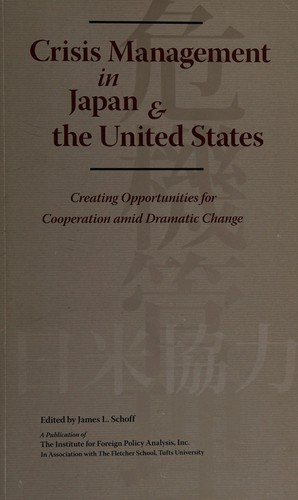
Crisis Management in Japan and the United States
0
0
As an Amazon Associate and affiliate partner, Menrva Books earns from qualifying purchases. Learn more
Author Description
In recent years, the United States and Japan have each undertaken a dramatic overhaul of various crisis and consequence management structures for the prevention of, and response to, natural and manmade disasters. Precisely at this time of organizational change, the two countries have a unique opportunity to incorporate new patterns of cooperation and to share appropriate resources and technologies for strengthening their abilities to protect their citizens, as well as those of less developed and/or capable third countries. This bi-national study by the Institute for Foreign Policy Analysis (IFPA) and the Osaka School of International Public Policy (OSIPP) at Osaka University examines four recent crises, including the Kobe earthquake, Tokaimura nuclear accident, and the September 11 terrorist attacks, and analyzes changes now underway in the military and civilian areas of crisis and consequence management in both countries. The study then outlines steps that policy makers can take to promote effective, efficient cooperation and make the most of the U.S.-Japan alliance.--BOOK JACKET.
Menrva's Summary
THE THESIS
This book investigates the structural reforms in crisis and consequence management undertaken by the United States and Japan in recent years. It examines how these two nations can leverage their organizational changes to foster new patterns of cooperation, share resources, and enhance their abilities to protect citizens. The study analyzes four specific crises—the Kobe earthquake, the Tokaimura nuclear accident, and the September 11 terrorist attacks—to understand the military and civilian adaptations in crisis management. Ultimately, it proposes actionable steps for policymakers to strengthen the U.S.-Japan alliance through effective and efficient cooperation.
THE SCOPE MAP
- Analysis of crisis and consequence management structures in the U.S. and Japan.
- Case studies of the Kobe earthquake, Tokaimura nuclear accident, and September 11 terrorist attacks.
- Examination of recent changes in military and civilian crisis management.
- Exploration of opportunities for U.S.-Japan cooperation in disaster response.
- Recommendations for policymakers to enhance bilateral crisis management capabilities.
THE AUTHORITY PERSPECTIVE
This bi-national study, a collaboration between the Institute for Foreign Policy Analysis (IFPA) and the Osaka School of International Public Policy (OSIPP), offers a comparative analysis of crisis management structures in the U.S. and Japan. The work is positioned as a timely examination of organizational reforms occurring concurrently in both nations. By analyzing specific disaster events and ongoing policy shifts, the book aims to provide practical insights for strengthening international cooperation. The proposed steps for policymakers are intended to leverage the U.S.-Japan alliance for enhanced disaster preparedness and response.
Page Count:
139
Publication Date:
2004-01-01
ISBN-10:
1574888943
Non-Fiction
History
Politics
Public Policy
Comparative Studies
International relations
Security Studies
Community Tags
Similar Books