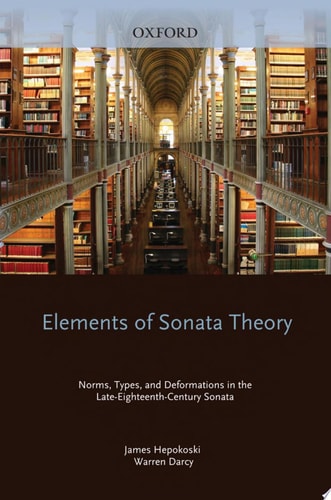
Elements of Sonata Theory: Norms, Types, and Deformations in the Late-Eighteenth-Century Sonata
0
0
As an Amazon Associate and affiliate partner, Menrva Books earns from qualifying purchases. Learn more
Author Description
Elements of Sonata Theory is a comprehensive, richly detailed rethinking of the basic principles of sonata form in the decades around 1800. This foundational study draws upon the joint strengths of current music history and music theory to outline a new, up-to-date paradigm for understanding the compositional choices found in the instrumental works of Haydn, Mozart, Beethoven, and their contemporaries: sonatas, chamber music, symphonies, overtures, and concertos. In so doing, it also lays out the indispensable groundwork for anyone wishing to confront the later adaptations and deformations of these basic structures in the nineteenth and earlier twentieth centuries. Combining insightful music analysis, contemporary genre theory, and provocative hermeneutic turns, the book brims over with original ideas, bold and fresh ways of awakening the potential meanings within a familiar musical repertory. Sonata Theory grasps individual compositions-and each of the individual moments within them-as creative dialogues with an implicit conceptual background of flexible, ever-changing historical norms and patterns. These norms may be recreated as constellations "compositional defaults," any of which, however, may be stretched, strained, or overridden altogether for individualized structural or expressive purposes. This book maps out the terrain of that conceptual background, against which what actually happens-or does not happen-in any given piece may be assessed and measured. The Elements guides the reader through the standard (and less-than-standard) formatting possibilities within each compositional space in sonata form, while also emphasizing the fundamental role played by processes of large-scale circularity, or "rotation," in the crucially important ordering of musical modules over an entire movement. The book also illuminates new ways of understanding codas and introductions, of confronting the generating processes of minor-mode sonatas, and of grasping the arcs of multimov
Menrva's Summary
THE THESIS
This book investigates the structural principles of sonata form in late-eighteenth-century music to establish a new analytical paradigm for understanding compositional choices. Authors James Hepokoski and Warren Darcy, both distinguished musicologists, synthesize historical context with formal theory to explain how composers like Haydn, Mozart, and Beethoven navigated established musical norms. By framing sonata form as a dialogue between flexible historical patterns and individual creative intent, the authors provide a rigorous methodology for assessing structural deviations and expressive choices in instrumental works.
THE SCOPE MAP
What You Will Find
- A comprehensive framework for analyzing sonata form in symphonies, concertos, and chamber music from the late eighteenth century.
- Detailed definitions of compositional defaults and the concept of structural deformations.
- An explanation of rotational processes and large-scale modular ordering within musical movements.
- Analytical strategies for interpreting codas, introductions, and minor-mode sonata structures.
THE AUTHORITY PERSPECTIVE
Experts widely recognize this work as a foundational text in modern musicology that has significantly shifted how scholars and performers approach the Classical canon. Readers frequently note the academic density of the prose, which requires a strong background in music theory to fully grasp the technical arguments presented.
Page Count:
691
Publication Date:
2011-01-01
Publisher:
Oxford University Press
ISBN-10:
0199890234
ISBN-13:
9780199890231
Music History
Sonata
Musicology
Academic
Humanities
Music Technology
Music theory
Community Tags
Similar Books




Reader Comments
Share Your Thoughts
No comments yet. Be the first to share your thoughts!