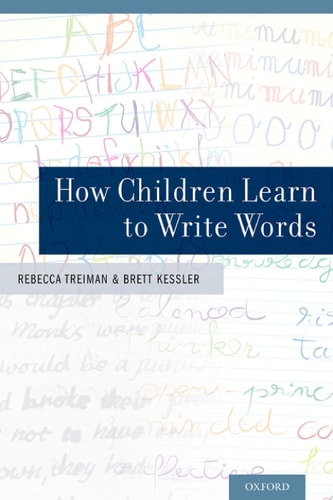
How Children Learn to Write Words
0
0
As an Amazon Associate and affiliate partner, Menrva Books earns from qualifying purchases. Learn more
Author Description
Writing allows people to convey information to others who are remote in time and space, vastly increasing the range over which people can cooperate and the amount they can learn. Mastering the writing system of one's language is crucial for success in a modern society. This book examines how children learn to write words. It provides a theoretical framework that integrates findings from a wide range of age groups--from children who are producing their first scribbles to experienced spellers who are writing complex words. To set the stage for these discussions, early chapters of the book consider the nature of writing systems and the nature of learning itself. The following chapters review various aspects of orthographic development, including the learning of symbol shapes and punctuation. Each chapter reviews research with learners of a variety of languages and writing systems, revealing underlying similarities. Discussions of how orthography is and should be taught are incorporated into each chapter, making the book of interest to educators as well as to psychologists, cognitive scientists, and linguists. This book is unique in the range of topics and languages that it covers and the degree to which it integrates linguistic insights about the nature of writing systems with discussions of how people learn to use these systems. It is written in a scholarly yet accessible manner, making it suited for a wide audience.
Menrva's Summary
THE THESIS
This book investigates the developmental processes by which children acquire the ability to write words within various orthographic systems. Authors Brett Kessler and Rebecca Treiman provide a comprehensive theoretical framework that synthesizes empirical research across multiple age groups, ranging from early scribbling to advanced spelling proficiency. By integrating linguistic theory with cognitive learning models, the authors examine how learners internalize the mechanics of writing systems and the implications for effective instruction.
THE SCOPE MAP
What You Will Find
- Analysis of orthographic development from initial symbol recognition to complex word construction.
- Comparative studies of diverse writing systems and languages to identify universal learning patterns.
- Examination of the role of punctuation and symbol shapes in early literacy acquisition.
- Evidence-based pedagogical insights for educators and cognitive scientists regarding writing instruction.
THE AUTHORITY PERSPECTIVE
Experts recognize this work as a significant contribution to the field of literacy development due to its cross-linguistic scope and integration of cognitive science. Readers frequently note that the text maintains a high level of academic rigor while remaining accessible to both practitioners and researchers.
Page Count:
416
Publication Date:
2014-01-01
Publisher:
Oxford University Press
ISBN-10:
0199907986
ISBN-13:
9780199907984
Psychology
Linguistics
Education
Community Tags
Similar Books