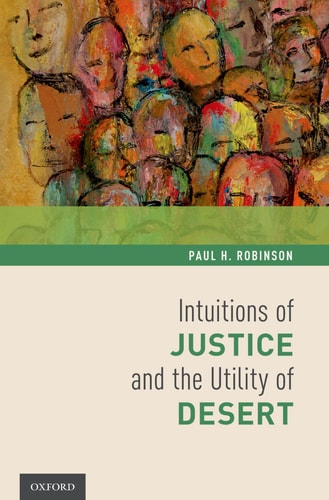
Intuitions of Justice and the Utility of Desert
0
0
As an Amazon Associate and affiliate partner, Menrva Books earns from qualifying purchases. Learn more
Author Description
Research suggests that people of all demographics have nuanced and sophisticated notions of justice. The core of those judgments is often intuition rather than reason. Should the criminal law heed what principles are embodied in those deep seated judgments?In Intuitions of Justice and the Utility of Desert, Paul H. Robinson demonstrates that criminal law rules that deviate from public conceptions of justice and desert can seriously undermine the American criminal justice system's integrity and credibility by failing to recognize or meet the needs of the communities it serves.Professor Robinson sketches the contours of a wide range of lay conceptions of what criminals justly deserve, touching upon many issues that penal code drafters or policy makers must face, including normative crime control, culpability, grading, sentencing, justification and excuse defenses, principles of adjudication, and judicial discretion. He warns that compromising the American criminal justice system to satisfy other interests can uncover the hidden costs incurred when a community's notions about justice are not reflected in its criminal laws.Intuitions of Justice and the Utility of Desert shows that by ignoring the views of justice held by the communities they serve, legislators, policymakers, and judges undermine the relevance of the criminal justice system and reduce its strength and credibility, creating a gap between what justice a community needs and what justice a court or law prescribes.
Menrva's Summary
THE THESIS
This book investigates whether the American criminal justice system should align its legal codes with the deep-seated, intuitive notions of justice held by the public. Paul H. Robinson, a professor of law, utilizes empirical research and legal analysis to argue that when criminal law deviates from community conceptions of desert, it risks losing its institutional credibility and effectiveness. The work provides a framework for understanding how public moral intuitions can and should inform legislative and judicial decision-making processes.
THE SCOPE MAP
What You Will Find
- Analysis of lay conceptions regarding culpability, sentencing, and grading of offenses.
- Examination of the systemic consequences of ignoring community-based justice norms.
- Discussion of normative crime control and the role of justification and excuse defenses.
- Evaluation of judicial discretion and the principles of adjudication in modern penal codes.
THE AUTHORITY PERSPECTIVE
Legal scholars and policy experts frequently cite this work as a critical examination of the disconnect between formal legal statutes and societal moral expectations. The text is recognized for its rigorous approach to integrating empirical social science data into traditional legal theory, making it a foundational resource for those studying criminal law reform.
Page Count:
584
Publication Date:
2013-05-03
Publisher:
Oxford University Press
ISBN-10:
0199917728
ISBN-13:
9780199917723
Criminology
Sociology
Public Policy
Administration of Justice
Criminal Law
Law