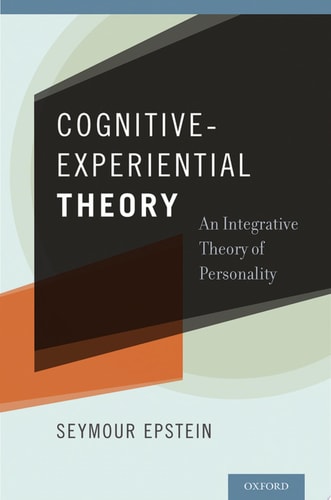
Cognitive-Experiential Theory: An Integrative Theory of Personality
0
0
As an Amazon Associate and affiliate partner, Menrva Books earns from qualifying purchases. Learn more
Author Description
The book presents a new theory of personality, referred to as cognitive-experiential theory (CET). Currently there are a variety of personality theories that seem irreconcilable with each other. CET is integrative of all other major personality theories. This integration is accomplished by expanding upon current basic assumptions, including the assumption that all higher-order animals automatically construct an implicit theory of reality that is necessary for adapting to their environments and that is therefore inherently reinforcing. The system that accomplishes this is referred to as the experiential system, as it is an empirical system that adapts by automatically learning from experience. Because it operates without requiring conscious awareness it can be regarded as an adaptive unconscious system, however, this book reveals that the experiential system is not identical with an unconscious adaptive system, and is superior to that construct in several important respects.Humans, of course, also uniquely operate with a conscious, reasoning system, referred to in CET as a rational system. This book demonstrates how these two systems operate in parallel and influence each other in important ways. For example, the influence of the experiential on the rational system can account for why the human species, despite its outstanding intelligence in solving impersonal problems, which are mainly in the domain of the rational system, often think and behave unintelligently and destructively in solving interpersonal problems, which are primarily in the domain of the experiential system. Yet, neither system is generally superior to the other, and the book discusses how each system is superior in uniquely important ways.
Menrva's Summary
THE THESIS
This work investigates the core question of how human personality functions through the interaction of two distinct, parallel processing systems. Seymour Epstein, a prominent psychologist, utilizes decades of research to propose Cognitive-Experiential Theory (CET) as an integrative framework. By synthesizing disparate personality theories, the author argues that human behavior is governed by both an automatic, experiential system and a conscious, rational system, explaining the frequent disconnect between human intelligence and interpersonal decision-making.
THE SCOPE MAP
What You Will Find
- A dual-process model of personality consisting of the experiential and rational systems.
- Theoretical integration of existing personality constructs into a unified framework.
- Analysis of the adaptive unconscious and its role in environmental navigation.
- Examination of the cognitive mechanisms behind irrational interpersonal behavior.
THE AUTHORITY PERSPECTIVE
Experts recognize this text as a significant contribution to personality psychology for its attempt to bridge the gap between cognitive science and traditional personality theory. Readers frequently note the academic density of the prose, which is intended for students and professionals in the field of psychology.
Page Count:
368
Publication Date:
2014-02-25
Publisher:
Oxford University Press
ISBN-10:
0199927553
ISBN-13:
9780199927555
Non-Fiction
Psychology
Personality Theory
Personality
Community Tags
Other Editions(2)
Similar Books