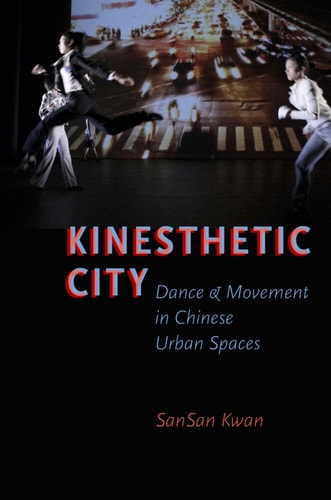
Kinesthetic City: Dance and Movement in Chinese Urban Spaces
0
0
As an Amazon Associate and affiliate partner, Menrva Books earns from qualifying purchases. Learn more
Author Description
In Kinesthetic City, author SanSan Kwan explores the contentious nature of Chineseness in diaspora through the lens of moving bodies as they relate to place, time, and identity. She locates her study in five Chinese urban sites--Shanghai, Taipei, Hong Kong, New York's Chinatown, and the San Gabriel Valley in Los Angeles--at momentous historical turning points to parse out key similarities and differences in the construction of Chineseness. The moving bodies she considers are not only those in performances by some of the most well-known Chinese dance companies in these cities, but also her own as she navigates urban Chinese spaces.By focusing primarily on kinesthesia--the body's awareness of motion--to gather information rather than more traditional modes of sight, sound, smell, touch, and taste, she highlights the importance of motion in the determination of space. In examining in these specific places at these precise historical moments, Kwan illuminates how moving bodies contribute to the production of those places and those moments. For Kwan, Chinese communities in diaspora provide particularly salient examples of how when and where our bodies are help to determine who we are. Whether engaged in otherwise unremarkable walking or in highly choreographed acts of political protest, human movement exists in dialogue with the kinesthetic of these city spaces, helping Chinese communities make meaning of themselves away from mainland China.As a whole, Kinesthetic City offers dance studies ways to extend movement analysis to study not only concert, folk or social dance, but also quotidian movement and urban flow.
Menrva's Summary
THE THESIS
This book investigates how human movement and kinesthetic awareness shape the construction of identity and place within Chinese urban centers and diasporic communities. Author SanSan Kwan, a scholar in performance studies, utilizes a framework centered on kinesthesia—the body's awareness of motion—to analyze how individuals navigate and define urban environments. By examining five distinct sites including Shanghai, Taipei, and New York's Chinatown, she argues that physical movement is a primary mechanism for producing meaning and identity in spaces outside of mainland China. The study integrates personal observation with formal dance analysis to demonstrate how quotidian and choreographed movements reflect historical and cultural shifts.
THE SCOPE MAP
What You Will Find
- Comparative analysis of five specific urban sites: Shanghai, Taipei, Hong Kong, New York's Chinatown, and the San Gabriel Valley.
- A methodological framework that prioritizes kinesthetic awareness over traditional sensory-based urban analysis.
- Examination of diverse movement types, ranging from professional dance performances to everyday walking and political protest.
- Theoretical application of dance studies to urban planning and the sociology of space.
THE AUTHORITY PERSPECTIVE
Scholars in performance and urban studies identify this work as a significant contribution to the field of dance ethnography. Readers frequently note the academic density of the prose and the innovative way the author bridges the gap between somatic experience and geopolitical identity.
Page Count:
224
Publication Date:
2013-01-04
Publisher:
Oxford University Press
ISBN-10:
0199921539
ISBN-13:
9780199921539
Sociology
China
Dance
Urban Studies
Asian Studies
Public Spaces
Performance Studies
Community Tags
Similar Books