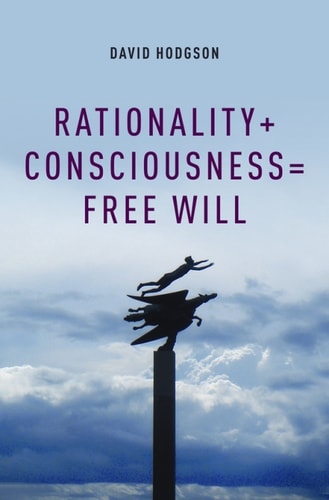
Rationality + Consciousness = Free Will: Philosophy of Mind
0
0
As an Amazon Associate and affiliate partner, Menrva Books earns from qualifying purchases. Learn more
Author Description
In recent years, philosophical discussions of free will have focused largely on whether or not free will is compatible with determinism. In this challenging book, David Hodgson takes a fresh approach to the question of free will, contending that close consideration of human rationality and human consciousness shows that together they give us free will, in a robust and indeterministic sense. In particular, they give us the capacity to respond appositely to feature-rich gestalts of conscious experiences, in ways that are not wholly determined by laws of nature or computational rules. The author contends that this approach is consistent with what science tells us about the world; and he considers its implications for our responsibility for our own conduct, for the role of retribution in criminal punishment, and for the place of human beings in the wider scheme of things.
Menrva's Summary
THE THESIS
Does the combination of human rationality and consciousness provide a basis for free will that is compatible with an indeterministic view of the universe? David Hodgson, drawing upon his background in legal theory and philosophy of mind, argues that human beings possess a capacity to respond to complex conscious experiences in ways that transcend simple computational rules or strict physical determinism. He posits that this framework aligns with contemporary scientific understanding while addressing the ethical implications of human agency and moral responsibility.
THE SCOPE MAP
What You Will Find
- An analysis of the intersection between human rationality and conscious experience.
- A defense of indeterministic free will within a scientifically informed worldview.
- Discussions on the implications for criminal justice, retribution, and human conduct.
Scope Limits
- The text does not provide a comprehensive history of all free will theories.
- It does not offer a purely neurobiological account of consciousness, focusing instead on philosophical and conceptual arguments.
THE AUTHORITY PERSPECTIVE
Critics and scholars frequently characterize Hodgson's work as intellectually rigorous and balanced, noting his ability to synthesize complex scientific concepts with philosophical inquiry. Experts often highlight the text as a significant contribution to the ongoing debate regarding agency and the limitations of physical determinism.
Page Count:
278
Publication Date:
2012-01-01
Publisher:
Oxford University Press
ISBN-10:
0190208600
ISBN-13:
9780190208608
Philosophy
Philosophy of
Metaphysics
Free Will
Responsibility
Determinism
Mind & Body
Community Tags
Similar Books