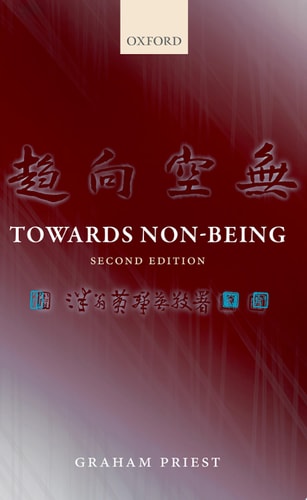
Towards Non-Being
0
0
As an Amazon Associate and affiliate partner, Menrva Books earns from qualifying purchases. Learn more
Author Description
Towards Non-Being presents an account of the semantics of intentional language--verbs such as 'believes', 'fears', 'seeks', 'imagines'. Graham Priest tackles problems concerning intentional states which are often brushed under the carpet in discussions of intentionality, such as their failure to be closed under deducibility. Priest's account draws on the work of the late Richard Routley (Sylvan), and proceeds in terms of objects that may be either existent or non-existent, at worlds that may be either possible or impossible. Since Russell, non-existent objects have had a bad press in Western philosophy; Priest mounts a full-scale defence. In the process, he offers an account of both fictional and mathematical objects as non-existent. The book will be of central interest to anyone who is concerned with intentionality in the philosophy of mind or philosophy of language, the metaphysics of existence and identity, the philosophy or fiction, the philosophy of mathematics, or cognitive representation in AI. This updated second edition adds ten new chapters to the original eight. These further develop the ideas of the first edition, reply to critics, and explore new areas of relevance. New topics covered include: conceivability, realism/antirealism concerning non-existent objects, self-deception, and the verb to be.
Menrva's Summary
THE THESIS
This work investigates the semantics of intentional language and the ontological status of non-existent objects. Graham Priest, a prominent logician and philosopher, utilizes a framework involving non-existent objects and impossible worlds to address the logical failures of intentional states. He challenges the traditional Western philosophical aversion to non-existent objects, arguing for their necessity in understanding belief, fear, and imagination.
THE SCOPE MAP
What You Will Find
- A semantic framework for intentional verbs like 'believes', 'fears', and 'seeks'.
- An ontological defense of non-existent objects, including fictional and mathematical entities.
- Analysis of impossible worlds and their role in cognitive representation.
- Ten additional chapters covering conceivability, self-deception, and realism.
Scope Limits
- The text does not provide a general introduction to philosophy, assuming a high level of familiarity with formal logic and analytic metaphysics.
- It does not focus on empirical psychological data, remaining strictly within the domain of philosophical semantics and logic.
THE AUTHORITY PERSPECTIVE
Experts recognize this text as a significant contribution to the study of intentionality and non-existent objects. Readers frequently note the high level of technical density and the rigorous logical argumentation required to engage with the author's propositions.
Page Count:
384
Publication Date:
2016-01-01
Publisher:
OUP Oxford
ISBN-10:
0191086266
ISBN-13:
9780191086267
Philosophy
Logic
Philosophy of
Mind & Body
Metaphysics
Semantics
Community Tags
Similar Books