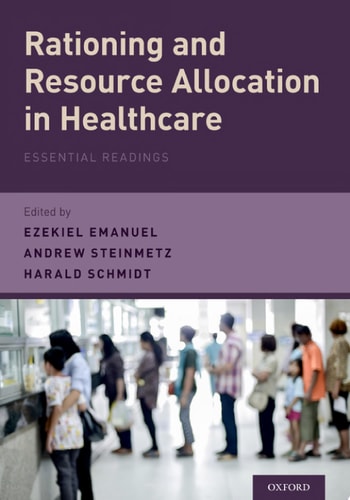
Rationing and Resource Allocation in Healthcare: Essential Readings
0
0
As an Amazon Associate and affiliate partner, Menrva Books earns from qualifying purchases. Learn more
Author Description
Budgets of governments and private insurances are limited. Not all drugs and services that appear beneficial to patients or physicians can be covered. Is there a core set of benefits that everyone should be entitled to? If so, how should this set be determined? Are fair decisions just impossible, if we know from the outset than not all needs can be met? While early work in bioethics has focused on clinical issues and a narrow set of principles, in recent years there has been a marked shift towards addressing broader population-level issues, requiring consideration of more demanding theories in philosophy, political science, and economics. At the heart of bioethics' new orientation is the goal of clarity on a complex set of questions in rationing and resource allocation.Rationing and Resource Allocation in Healthcare: Essential Readings provides key excerpts from seminal and pertinent texts and case studies about these topics, contextualized by original introductions. The volume is divided into three broad sections: Conceptual Distinctions and Ethical Theory; Rationing; and Resource Allocation. Containing the most important and classic articles surrounding the theoretical and practical issues related to rationing and how to allocate scare medical resources, this collection aims to assist and inform those who wish to be a part of bioethics' 21st century shift including practitioners and policy-makers, and students and scholars in the health sciences, philosophy, law, and medical ethics.
Menrva's Summary
THE THESIS
This volume investigates the ethical and practical frameworks required to manage the inevitable scarcity of medical resources within healthcare systems. The authors, including noted bioethicist Ezekiel J. Emanuel, curate a collection of seminal texts that bridge the gap between clinical bioethics and population-level policy. By synthesizing perspectives from philosophy, economics, and political science, the book argues that transparent and structured decision-making is necessary to address the limitations of government and private insurance budgets.
THE SCOPE MAP
What You Will Find
- Conceptual distinctions between rationing and resource allocation
- Ethical theories applied to healthcare distribution
- Case studies illustrating real-world allocation dilemmas
- Original editorial introductions providing context for classic articles
Scope Limits
- Does not provide a singular, universal policy solution for all healthcare systems
- Focuses primarily on theoretical and ethical frameworks rather than specific clinical medical procedures
THE AUTHORITY PERSPECTIVE
Experts identify this collection as a foundational resource for students and policy-makers navigating the complexities of modern medical ethics. Readers frequently note the academic density of the prose, which serves as a comprehensive primer for those entering the field of health policy.
Page Count:
564
Publication Date:
2018-01-01
Publisher:
Oxford University Press
ISBN-10:
0190200766
ISBN-13:
9780190200763
Economics
Philosophy
Bioethics
Public Health
Medical Ethics
Healthcare Policy
Community Tags
Similar Books