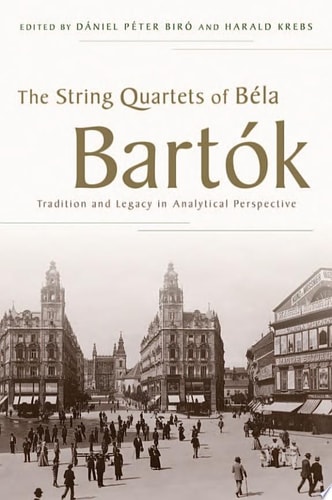
The String Quartets of Béla Bartók: Tradition and Legacy in Analytical Perspective
0
0
As an Amazon Associate and affiliate partner, Menrva Books earns from qualifying purchases. Learn more
Author Description
Béla Bartók (1881-1945) was one of the most important composers and musical thinkers of the 20th century. His contributions as a composer, as a performer and as the father of ethnomusicology changed the course of music history and of our contemporary perception of music itself. At the center of Bartók's oeuvre are his string quartets, which are generally acknowledged as some of the most significant pieces of 20th century chamber music.The String Quartets of Béla Bartók brings together innovative new scholarship from 14 internationally recognized music theorists, musicologists, performers, and composers to focus on these remarkable works from a range of theoretical and methodological perspectives. Focusing on a variety of aspects of the string quartets-harmony and tonality, form, rhythm and meter, performance and listening-it considers both the imprint of folk and classical traditions on Bartók's string quartets, and the ways in which they influenced works of the next generation of Hungarian composers. Rich with notated music examples the volume is complemented by an Oxford Web Music companion website offering additional notated as well as recorded examples. The String Quartets of Béla Bartók, reflecting the impact of the composer himself, is an essential resource for scholars and students across a variety of fields from music theory and musicology, to performance practice and ethnomusicology.
Menrva's Summary
THE THESIS
This volume investigates the structural, historical, and cultural significance of Béla Bartók’s string quartets as foundational works of 20th-century chamber music. Edited by Dániel Péter Biró and Harald Krebs, the text compiles research from fourteen international experts to analyze how Bartók synthesized folk traditions with classical forms. The contributors utilize diverse analytical frameworks to examine the composer's influence on subsequent generations of Hungarian musicians and the evolution of modern musical perception.
THE SCOPE MAP
What You Will Find
- Comprehensive analysis of harmony, tonality, form, rhythm, and meter within the six string quartets.
- Methodological approaches to performance practice and the act of listening to complex 20th-century compositions.
- Integration of folk music influences and their intersection with Western classical traditions.
- Extensive use of notated music examples and supplementary digital resources via the Oxford Web Music companion site.
THE AUTHORITY PERSPECTIVE
Experts identify this collection as a rigorous, multi-faceted resource for musicologists and advanced students of theory. Readers frequently note the academic density of the prose and the value of the provided musical notation in supporting the theoretical arguments presented.
Page Count:
353
Publication Date:
2014-05-23
Publisher:
Oxford University Press
ISBN-10:
0199936188
ISBN-13:
9780199936182
Biography
Music
Music theory
Musicology
Community Tags
Similar Books